

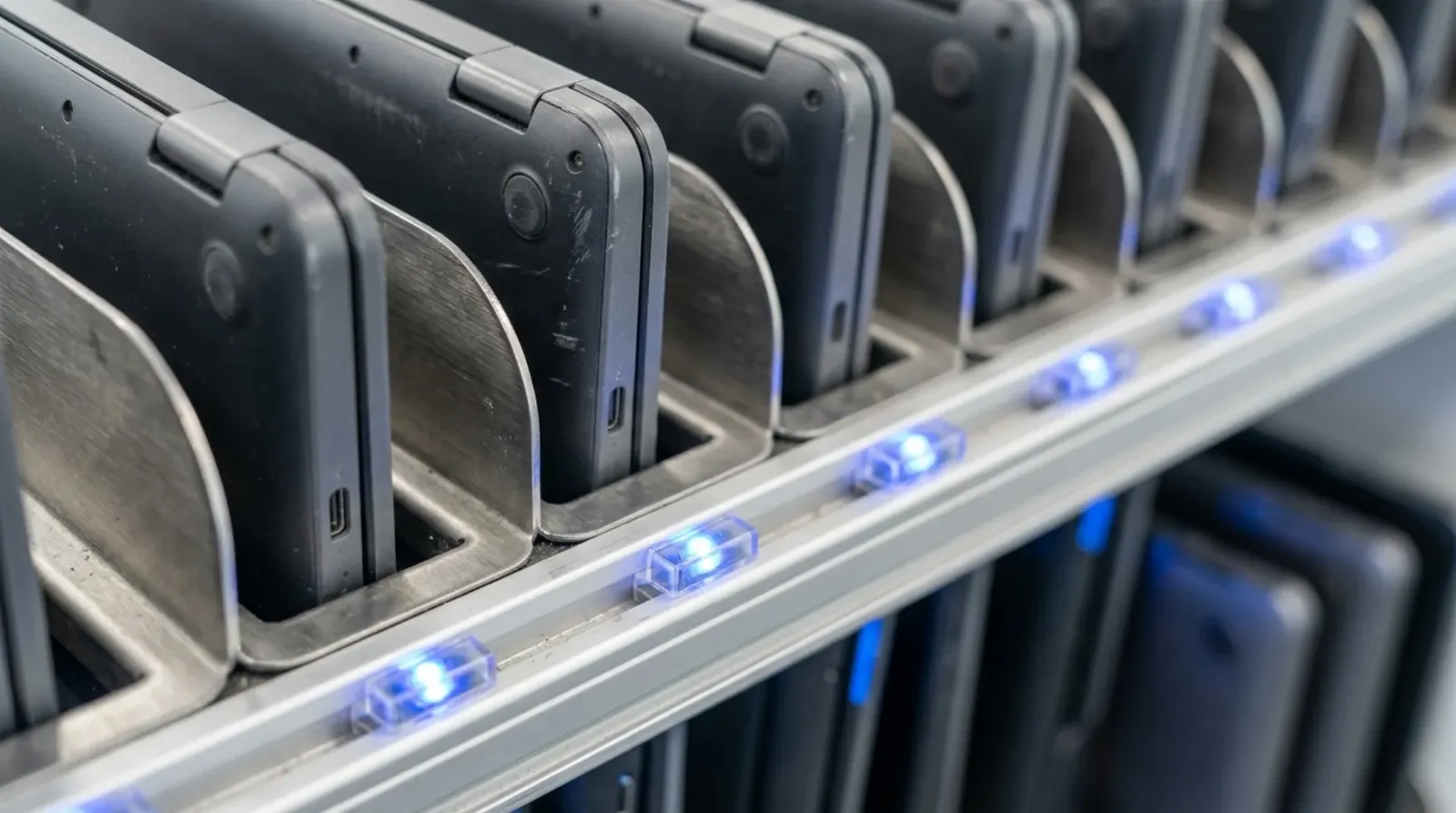
Learning platforms that hold up when the whole cohort arrives
Education software has a load pattern nothing else has. Everyone appears in the same five minutes, does the same thing, and notices instantly when it lags.
What makes learning software different
5 things that decide this
- 01Traffic in education is not a curve, it is a spike. A class starts at nine, so average load tells you nothing useful and the only test that matters is the synchronised one.
- 02One organisation is never one organisation. A school district, a university and a corporate buyer all need separate tenants with their own users, roles and invitations, which is why retrofitting multi-tenancy is such an expensive rebuild.
- 03Manual setup does not scale with enrolment. Go4Gr8 spent over two hours preparing each new user on a no-code tool. On the platform we built, a new user is active in under 15 minutes.
- 04Completion is not learning, and buyers increasingly know it. If a system cannot show what someone got wrong and what changed afterwards, the renewal conversation is difficult.
- 05Children's data carries obligations most teams discover late. Decide who your users are before you design sign-up, because consent and retention rules follow that answer.
Everyone shows up at the same moment
A shopping site with a thousand daily users sees them trickle in. A learning platform sees all of them in the first minute of a session, submitting the same answer to the same question.
That pattern breaks things a normal load test never touches. On Elevent we built a live game engine over WebSockets. It keeps scores and answers in sync for events running from 10 participants to more than 1000 at once, and it clusters across servers. One machine holding every open connection is a single point of failure with a launch date attached.
Test against the worst hour rather than the average one. If your platform is for schools, the worst hour is the first Monday of term, and everyone in the building knows when it went wrong.
- 01Load-test the simultaneous case, not the daily total.
- 02Degrade in an order you chose. Reporting can wait; a live session cannot.
- 03Real-time state belongs in a shared store, so a second server can pick up the room.
Relevant work
1000+
participants in a single live Elevent session
2 hours to 15 min
onboarding a new Go4Gr8 user after the rebuild
22
production systems across the firm
- JoinA thousand connections in one minute.
- SyncEveryone sees the same question.
- AnswerSubmissions land together.
- ScoreLive, and consistent for all.
- RecoverA dropped phone rejoins mid-session.
- RecordWhat each person actually got wrong.
Recovery is the step teams skip. On a school network a device drops constantly, and a learner who cannot rejoin is a support call from a teacher standing in front of a class.
Where we are useful
Live, synchronous sessions
Elevent runs real-time multiplayer sessions for training and corporate events, with three game modes and one admin portal for questions, rules and live monitoring. Containerised on AWS with automated scaling.
Multi-tenant from the start
Go4Gr8 gives each organisation its own users, roles and invitations, with dedicated AI agents per person. That structure is what turned a good idea into something the client could sell to enterprises.
Automated onboarding
Invitations, welcome emails, nudges and progress tracking that run without staff. Go4Gr8 went from over two hours of manual setup per user to under 15 minutes.
Assessment that proves something
WAIQ pairs training modules with quizzes and shows leaders live readiness by site, department and role. Completion is easy to record. Readiness is the number people buy.
Starting on a no-code tool is fine. Staying is not
Go4Gr8 built its first version on an off-the-shelf AI tool, and that was the right call. It proved people wanted the product before anyone spent money on infrastructure.
The ceiling arrived with the first enterprise buyer. There was no way to model an organisation, so every new user meant more than two hours of manual setup by a human. The product could be sold once. It could not be sold repeatedly.
That is the moment to rebuild, and your trigger is a shape rather than a user count. Once a sale creates manual work that grows with it, the tool has stopped being an accelerator.
- The signal is manual setup per customer, not traffic.
- Model the organisation before the feature list. Everything else assumes it.
- Move the data model first. The interface is the cheap part to rebuild.
Platforms built for cohorts and live sessions
“Their attention to detail, quality of employees, and work ethic were outstanding.”
Nicolas de Quesada · CEO, Lexpair
The stack behind these platforms
Real-time
Built with
Around the platform
Questions buyers ask us first
01Will the platform survive a whole class starting at once?
Only if it was built for simultaneous load, and most platforms are not. Elevent keeps a live session in sync for 10 to over 1000 participants by clustering its real-time layer across servers with a shared state store. Test your synchronised minute rather than your daily total. The daily total looks healthy right up to the failure.
02When should we move off our no-code tool?
When each new customer creates manual work that grows with the sale. Go4Gr8 hit that wall at over two hours of setup per user, with no way to represent an organisation. After the rebuild, onboarding took under 15 minutes and enterprise pilots became possible. User count is the wrong trigger to watch.
03Can you integrate with the learning management system a client already uses?
Usually yes, and we confirm the integration path before quoting. LTI 1.3 is the target for anything modern, and the flow depends on the platform's own tool registration. Ask any vendor which specific system and version they connected to. A Canvas launch and a Blackboard launch are the same specification and different days of work.
04How do you show that someone actually learned something?
Record the attempt, not only the completion. What was answered wrongly, what changed on the retry, and how long the gap lasted. WAIQ reports readiness by site, department and role rather than a completion percentage, and that is the number a buyer will renew on.
05What about data protection for younger learners?
Settle who your users are before you design sign-up, because consent, retention and deletion rules follow from their age and their country. This is a legal question with an engineering consequence, so we would want your counsel involved early. We build the controls their answer requires.
06Can you work alongside our in-house team?
Yes, and it is a common shape for this work. Senior engineers join your team and your process rather than running a separate project in parallel. Scoping calls are free. Where the work starts inside your existing codebase, there is a paid two-week diagnostic ending in a fixed price.
Go deeper
- AI prototype to production →Moving a working demo onto infrastructure that scales.
- Staff augmentation →Adding senior engineers to a team you already have.
- Custom software development →How we scope and build platforms like these.
- Education and learning work →Learning software is judged the day the whole cohort logs in.
