

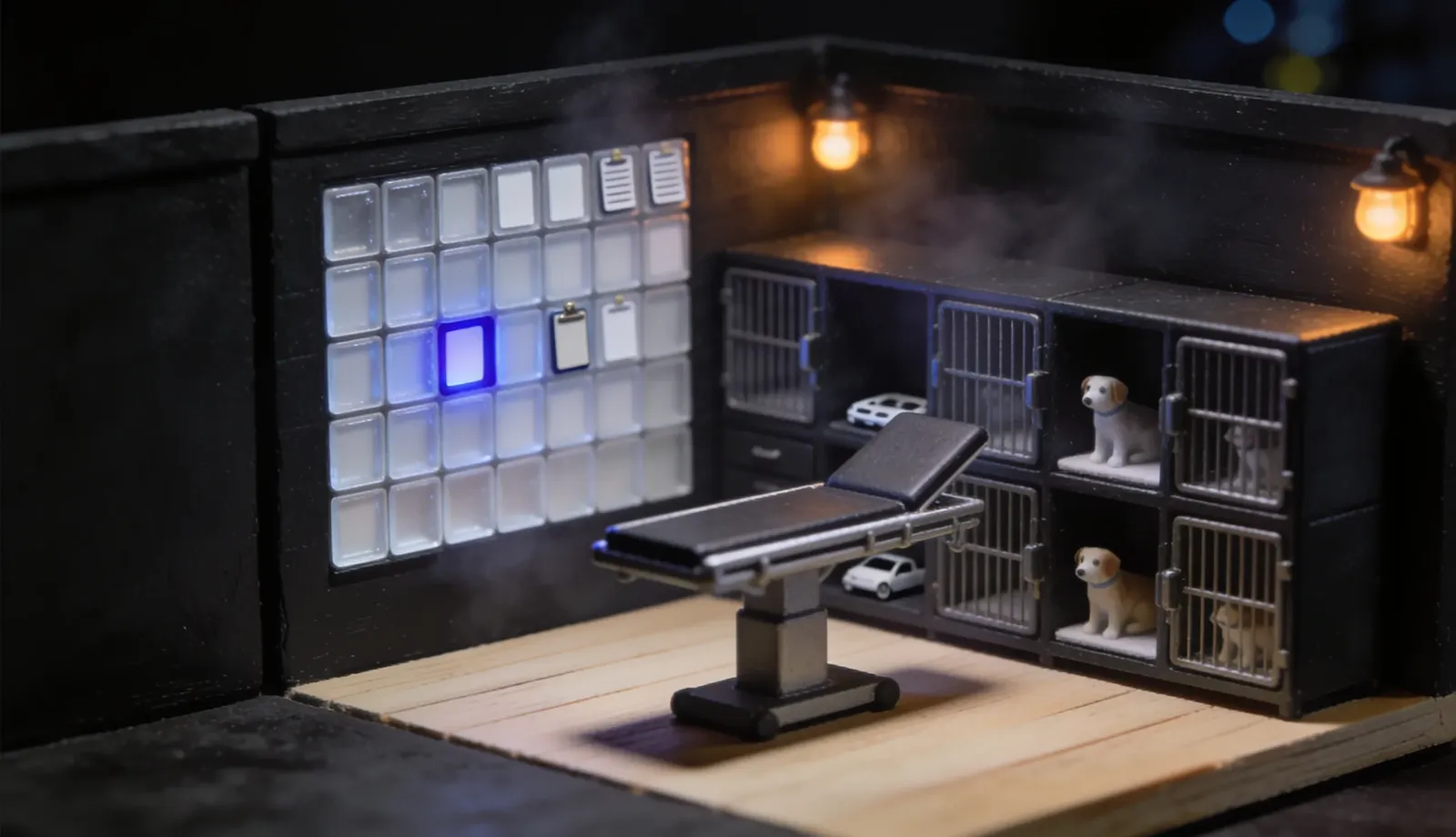
A vet clinic needs to know which care was missed
A vet clinic or kennel only sees missed care when the system knows the schedule first and treats a missing check-in as a fact.
Key takeaways
6 things that decide this
- 01A vet clinic or boarding kennel can only see missed care if the system knows the schedule first and treats a missing check-in as a fact, because paper records what happened and never what didn't.
- 02A treatment sheet shows the care someone remembered to write down. The gap is the care nobody logged.
- 03When staff check in and out of each task, the system can compare what was planned with what was logged and flag the difference.
- 04Trident Elite, a protection-dog training and boarding business, runs on an app we built that does exactly this. It's animal care, not a vet clinic, but the pattern carries over.
- 05Your practice management system, whether ezyVet, Cornerstone or Provet Cloud, stays the medical record. The missed-care layer sits beside it.
- 06The trade-off: this only works where you can say in advance what should happen.
Why does paper only show the care someone remembered?
Walk into most clinics and boarding wards and you will find the same tools. A whiteboard by the kennels. Treatment sheets clipped to each run. A boarding log that a tech fills in at the end of a busy shift.
These tools do one job well. They record what someone did. A tech gives the 2 p.m. dose, ticks the box, and initials it. That tick is real evidence.
The trouble is the box nobody ticked. A blank cell on a treatment sheet could mean the dose was missed. It could also mean it was given and not written down. Or the sheet was swapped at shift change. Paper can't tell these apart, so nobody acts on a blank.
That's the one thing a practice owner most needs to know. Not what happened, but what didn't. A missed medication, a skipped walk, a wound check that slid to the next shift. On paper, these stay hidden until a client or a patient shows the result.
- 01A tick proves care happened. A blank proves nothing.
- 02Shift changes are where blanks pile up.
- 03Owners usually learn about a missed task from its outcome, not from the record.
How does software flag care that never happened?
The fix isn't a better form. A form can only capture what someone did. It can't capture the task nobody did.
So the system has to know the plan first. If the plan says this patient gets a dose at 2 p.m., or this dog gets walked twice a day, the system holds that as an expected event. Staff then check in and out of each task as they do it.
Now a missing check-in is a fact the software can see. When 2 p.m. passes with no check-in against that patient, the system raises a flag. Nobody has to own up to it, and nobody has to audit a stack of sheets to find it.
This is the core of what we built for Trident Elite. Staff check in and out of every activity. Each entry is stamped with the dog, the staff member and the time. Because the schedule is known, the app works out a missed activity from the check-in that never came.
- 01Hold the plan as expected events, not as notes.
- 02Log each task with who, what and when.
- 03Compare the two and flag the difference on its own.
What does this look like in a working kennel?
Trident Elite Protection Dogs trains, boards and cares for protection dogs. To be plain about the setting: this is a training and boarding business, not a veterinary clinic. But the daily problem is the same one a clinic ward or boarding kennel has. Many animals, many tasks, many hands, and a record that only shows what got written down.
Before the app, the business ran on paper and whiteboards. We built the kennel management web app it now runs its day on. Every dog, kennel and staff member sits in one system.
Health reports sit with each dog. Staff record eyes, ears, teeth, coat and weight, and those reports build into a history the owner can pull up later. That turns a one-off note into a trend you can actually read.
The owner signs in to a separate view with analytics, the missed-activity flags and a full activity log. The question an owner used to answer by walking the kennels is now answered on one screen.
Why should the care log be append-only?
A missed-care flag is only useful if people trust the log behind it. If anyone can edit an entry after the fact, the log turns into a record of who fixed it last.
So Trident Elite's activity log is append-only. Staff add entries; they don't edit or delete old ones. A correction is a new entry, with its own name and time, sitting next to the original.
That matters for a clinic too. When a client asks whether their pet got a medication, you want an answer you can stand behind. An append-only log gives you one, and it protects the staff member who did the work as much as it catches the gap.
- 01Corrections are new entries, never overwrites.
- 02Each entry carries a person and a time.
- 03The log protects the staff who did the work as well as the owner.
Why split the staff view from the owner view at the server?
Staff and owners need different things. A tech needs today's tasks and a fast way to check in. An owner needs patterns across weeks: which shifts miss most, which tasks slip, which animals need a closer look.
In Trident Elite's app, staff and owner privileges are split at the server, rather than hidden in the menu. Each role only reaches its own screens and its own data. A hidden button can still be reached; a rule on the server can't be skipped.
For a clinic, the same split keeps staff focused on the work in front of them. It also keeps owner reports and staff performance data where they belong.
Where do ezyVet, Cornerstone or Provet Cloud fit?
If you run a clinic, your patient records, invoices and appointments probably live in ezyVet, Cornerstone or Provet Cloud. That should not change. The practice management system stays the medical record.
A missed-care layer sits beside it. It reads what it needs, such as which patients are in and what is scheduled for them. Then it adds the piece the PIMS was not designed for: a live comparison of planned tasks against logged ones.
How much it can read, and whether it can write anything back, depends on what each vendor exposes through its public API. That access varies by vendor and by account, so we check it on your account first, before we commit to a design.
There is a real trade-off here. This pattern only works where you can say in advance what should happen. Scheduled doses, walks, feeds and checks fit well. Emergency work and judgement calls don't, and forcing them into a schedule creates noise, not signal. Start with the tasks you already plan.
- 01The PIMS keeps the medical record.
- 02The new layer compares planned tasks with logged ones.
- 03Start with tasks you can schedule; leave emergencies out.
Where should a clinic start?
Pick one ward or one boarding block. List every task you expect to happen there each day, with a time. Then look at last week's sheets and count the blanks. That count is the size of the problem you can't see today.
If you want help turning that into a working system, start with a 45-minute call. From there we write a fixed-fee Blueprint from your real systems and workflows, credited in full against the build. You can read how that works on how we work, or see our veterinary software work.
Questions this raises
01Who builds custom software for veterinary clinics?+
Custom-software firms that build beside your practice management system rather than replacing it. Hashlogics builds tools like missed-care tracking, check-in logs and owner dashboards that sit next to ezyVet, Cornerstone or Provet Cloud. Our closest shipped example is Trident Elite, a protection-dog training and boarding business, where the app flags any scheduled activity that never got a check-in.
02Which development firms integrate custom tools with ezyVet, Cornerstone or Provet Cloud?+
Any firm that works through each vendor's public API can connect a custom tool, within the limits that API sets. Ask a firm to show you which records it can read and write on your account before it quotes. Hashlogics confirms that API access on your account in the Blueprint, before it commits to a design.
03Is custom software better than ezyVet or Cornerstone for a veterinary clinic?+
Usually not as a replacement. ezyVet and Cornerstone are mature practice management systems, and your medical records should stay there. Custom software makes sense for the gap they leave, such as flagging missed treatments against a schedule, or a workflow unique to your clinic. Build beside the PIMS, not instead of it.