

Trident Elite
A kennel that knows which care was missed.
An operations web app where staff check in and out of every activity, so missed care shows up for the owner without anyone reporting it.
- Client
- Trident Elite Protection Dogs
- Industry
- Animal care · Protection-dog training and boarding
- Engagement
- Operations web app · Full-stack development
Trident Elite Protection Dogs runs its day on a kennel management web app that Hashlogics built. Staff check in and out of every activity, and the app flags any activity that never got a check-in. Paper and whiteboards only show the care someone remembered to write down. So the one thing the owner needs to know, what didn't happen, stayed hidden.
The problem we set out to solve.
Nobody could say for sure which dog got which care, from whom, and when.
A missed activity only came to light if someone chose to mention it, which is a welfare risk for a high-value animal.
Health notes were scattered instead of held against each dog.
Paper could record that something happened, but it had no way to show that something didn't.
To see how the day went, the owner had to ask staff and piece it together.
What success needed to look like
- Tie every activity to a dog, a person and a time.
- Flag missed activities automatically.
- Pull up the health reports for any one dog.
- Give the owner analytics across the whole kennel, without a daily debrief.
How we delivered it.
- 01
Model the kennel as records
Dogs, kennels and staff became first-class records, so every later entry has something real to point at.
- 02
Capture care as it happens
Staff check in and out of each activity. That stamps every entry with the dog, the staff member and the time.
- 03
Work out what was missed
Because the schedule is known, the app compares expected activities with logged ones and flags the gaps itself.
- 04
Split the app by role
Staff get a view built around checking in and out, while the owner gets analytics, flags and the log. That split is enforced at the server, so a hidden menu item is never the only lock.
- 05
Keep the log append-only
Activity records are only ever added. Each one stays tied to its dog, person and timestamp, so nobody can reassign an entry later.
What we built.
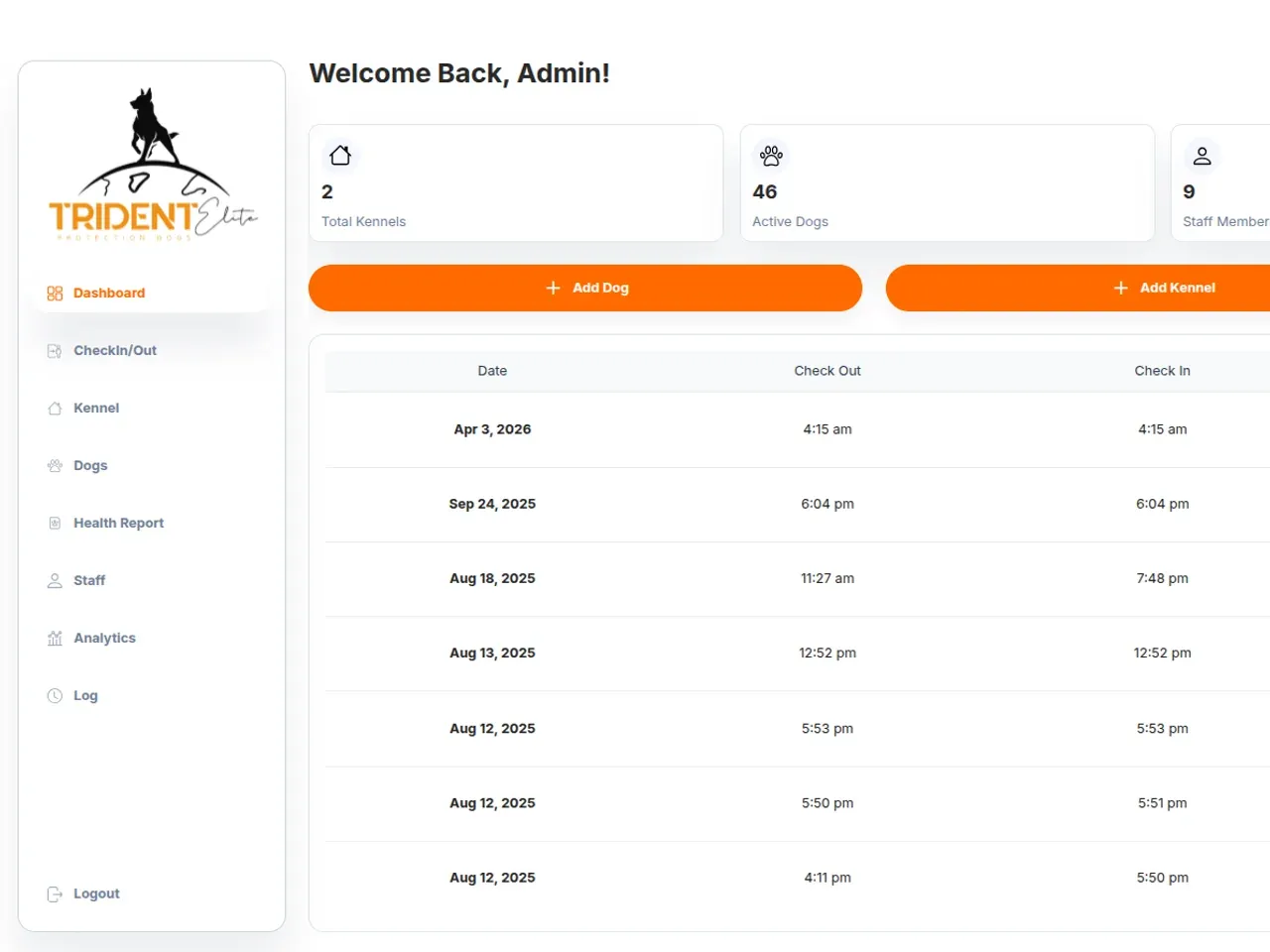
Trident Elite's app holds every dog, kennel and staff member in one system. Staff check in and out of each activity, so each one is logged against a dog, a person and a time. Because the schedule is known, the app works out a missed activity from the check-in that never came. Nobody has to own up to it.
Health reports sit with each dog and build into a history you can pull up later. The owner signs in to a separate view with analytics, the missed-activity flags and a full activity log. Staff and owner privileges are split at the server, so each role only reaches its own screens and data.
- Check-inA staff member checks in and out of an activity for a dog.
- Activity recordThe entry carries the dog, the staff member and the time.
- Schedule checkLogged activities are compared with the expected ones.
- Missed flagAny gap is flagged instead of passing in silence.
- Owner viewAnalytics and the full log show the owner the day.
A missed activity is worked out from what didn't happen, so it never depends on self-reporting.
Platform capabilities
- Role-based access control
- Check-in / check-out tracking
- Missed-activity detection
- Health records
- Analytics
- Activity logging
Architecture
- Web app with role-based views
- Server-enforced permissions
- Append-only activity records
- Analytics built on the activity log
Data model
- Dogs
- Kennels
- Staff
- Activity records
- Health records
Users
- Kennel staff
- Owner
The core idea was recording something that never happened. A form can capture an activity a staff member did, but it can't capture the one nobody did. So the app had to know the schedule first, then treat a missing check-in as a fact worth flagging. This only works where you can say in advance what should happen. If your operation runs on daily checks like that, the absence is the data you're missing.
