

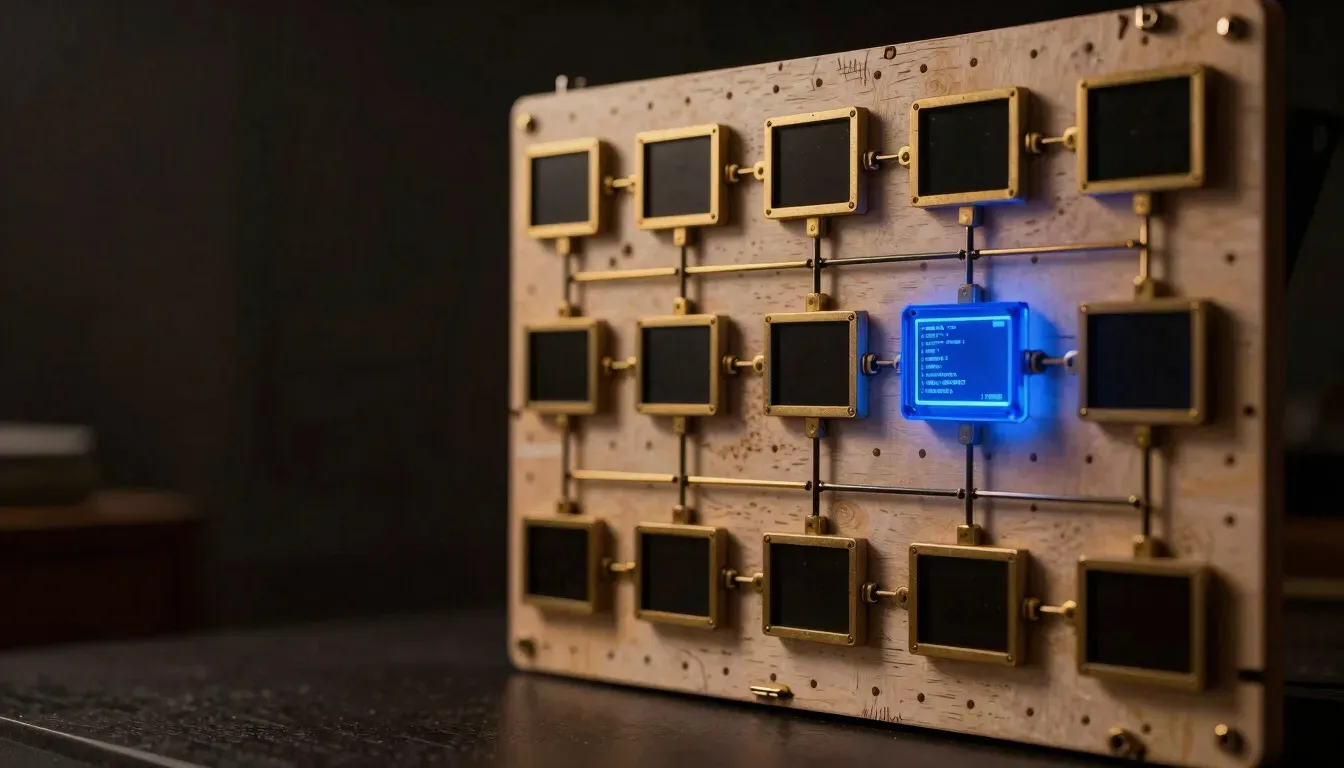
n8n is a codebase. Treat it like one.
The moment a workflow decides what happens to a lead, an invoice, or a task, it has become part of your operations. It deserves the same discipline as the rest of your code.
The short version
5 things that decide this
- 01A workflow that routes real business decisions is production code, whether or not anyone treats it that way.
- 02Editing live in the n8n canvas with no version history means a bad change has no path back except memory.
- 03Most teams run one n8n instance for everything, so a change made to test an idea is already live for every real execution.
- 04Little Tree Confections' workflow logic lives in Git, and the production canvas is not where changes get tried first.
- 05Version control, a separate environment to test in, a review step, and a rollback plan are the four habits that make the difference.
When a workflow stops being a shortcut
The first n8n workflow a team builds is usually small: forward this form to Slack, add this row to a sheet. Nobody applies engineering discipline to that, and they shouldn't. It's a shortcut, and shortcuts don't need a review process.
The shift happens quietly. A workflow starts deciding which department gets a task, which lead gets a follow-up, or which invoice gets flagged. At that point it is no longer a convenience. It runs a piece of the business, on a canvas that looks the same as it did when the stakes were low.
Nobody decides this on purpose. The workflow just keeps growing new nodes and new dependencies until, one day, a broken execution costs someone a real customer or a missed deadline. By then the habits that would have caught it were never built.
- 01A workflow that only notifies someone stays low-stakes indefinitely.
- 02A workflow that assigns, routes, or filters is making decisions nobody double-checks.
- 03The transition from one to the other rarely gets a decision point of its own.
- 04By the time it's obvious, the workflow already has months of undocumented edits behind it.
The four habits code has and workflows usually don't
A developer would not push an untested change straight to the system serving customers. Most n8n setups do exactly that, because the canvas makes editing live so easy nobody stops to ask if they should.
Four habits close most of the gap. None of them need new tooling beyond what n8n already ships or connects to.
- 01Version control: workflow JSON committed to Git on export, so every change has a diff and an author instead of a canvas that only shows its current state.
- 02Separate environments: a staging n8n instance for anything untested, so a new node or a changed condition runs against real data before it runs against real customers.
- 03Review before merge: a second person reads the diff before a workflow change reaches production, the same gate a pull request gives application code.
- 04A rollback path: the last known-good version, ready to redeploy in minutes rather than rebuilt from memory.
What this looks like on a real build
Little Tree Confections runs an n8n automation that turns every Fireflies meeting transcript into ClickUp tasks. Each one routes to the correct department with no manual handoff. That routing decision is exactly the kind of logic that has no business changing on a live canvas with no history behind it.
The workflow's logic lives in Git, with execution logs and error handling built in rather than added after a failure. Changes get tested against past transcripts before they touch a live meeting. The workflow also reads the current ClickUp department structure instead of a hardcoded list. A department change never forces an emergency edit to the routing logic.
None of this is exotic. It is the same discipline a small application team applies without discussion, moved onto a tool that lets you skip it if nobody insists otherwise.
Questions this raises
01Do I need a separate n8n instance for staging?+
For any workflow that touches real customers, invoices, or task assignment, yes. A second instance, even a small one, means an untested change runs against test data first instead of a live execution. The cost of running it is small next to the cost of a routing bug nobody caught before it ran.
02How do I version control n8n workflows if they live in a visual canvas?+
n8n workflows export as JSON. Committing that export to Git on every meaningful change gives you a diff and an author for each change, the same as application code. It has to be a deliberate step. The canvas itself keeps no history of its own beyond n8n's built-in execution log.
03What's the minimum viable version of this for a small team?+
Export the workflow JSON to Git after every change, and keep the last working version ready to re-import if something breaks. That alone gives you a rollback path, which is the habit that matters most when a workflow decides real outcomes.
Related
- n8n in production →Our review of the tool this discipline applies to.
- Hire n8n developers →What to look for when the workflow needs an engineer, not a hobbyist.
- Best n8n automation agencies →How to evaluate who builds and maintains a workflow like this one.
- Little Tree Confections: meeting-to-action automation →The production workflow this piece draws from.
