


EHR integration for practices: the chart as the system of record, and everything else writing to it
Your EHR does most of the job well. Your staff do the last 20% by hand: the intake form re-typed, the lab result scanned and filed, the referral faxed, the note finished at 9pm. Works with athenahealth, Epic, Dentrix, ezyVet or whatever you run.
- 4.8 on Clutch across 22 reviews
- PremiumAudit.io: audit cycle cut 75%, calculation errors cut 95%
- In production for SmartREI, Tankaware, ZyloBase, KiwiWrite
What you get
3 things that decide this
- 01One path into your chart, instead of five people re-keying the same demographics. Intake, lab, imaging and referral results land where your clinicians already look.
- 02Documentation drafted into your own template from the encounter, with your clinician reading it and signing it. Nothing goes into a chart unsigned, and nothing clinical is decided by software.
- 03An access model we confirm in writing before we quote. Epic, athenahealth, Dentrix, Open Dental and ezyVet each open up to a different depth, and some need a vendor programme to get in at all.
From the intake form to the signed note, and what each step writes back
Three stations the integration layer owns. Pick your system to see the write-back. Epic, Open Dental, Cornerstone, NextGen and AVImark follow the same pattern, as far as their access model allows.
Station 01 · The visit and the chart
- Today
- Your clinicians chart after hours. Intake forms get re-typed into the EHR, and the lab, imaging and referral systems reach it through a person.
- What we automate
- Intake that lands in the chart with nothing re-keyed. Notes drafted into your own template from the visit. And the links your vendor won't build: FHIR and HL7 where they exist, the vendor's API where they don't, a reviewed queue where neither does.
- What stays human
- Your clinician signs every note and makes every clinical decision. Drafting is assistance; the signature is theirs.
Writes to athenahealthEncounter documentation in your template, pending signature.
Station 02 · Intake and the systems around the EHR
- Today
- A patient fills your form on paper, or in a portal that doesn't write back. Someone then re-types the demographics, the history and the insurance card into the chart. Labs come back by fax or a portal login, imaging sits with the imaging centre, and a referral gets chased by phone until somebody remembers.
- What we automate
- Structured intake that maps to your chart fields. Results routed from the lab, imaging and referral systems to the right patient and the right clinician. Your PMS, your EHR and your clearinghouse kept in step, instead of squared up by hand every Friday.
- What stays human
- Your staff match anything unclear. A result we can't pin to one patient stops in a queue for a person. Nothing gets filed on a guess.
Writes to athenahealthPatient demographics, insurance and intake answers on the record; results and documents attached to the encounter.
Station 03 · Documentation into your template
- Today
- Notes get written between patients, or after the last one leaves. Your practice agreed on a template, and it gets half-filled because there's no time.
- What we automate
- Scribe-style drafting from the visit into your own template. Codes and orders get proposed, never applied. One randomised trial of 238 physicians put the better of two ambient AI scribes at 41 seconds saved per note (Lukac et al., NEJM AI, 2025). We treat it as one useful piece of the chart problem, not the whole of it.
- What stays human
- Your clinician reads the draft, edits it and signs it. Nothing reaches a chart or a claim without that signature. A diagnosis is never the software's.
Writes to athenahealthDraft encounter note in your template with proposed codes, pending signature.
Before these come the phone, the schedule and eligibility. After them come the claim and the owner's numbers. Our healthcare hub walks the whole chain.
Four things the integration layer does, and what each one plugs into
FHIR, HL7 and the vendor's own API
Epic runs a developer programme and exposes FHIR; athenahealth has a marketplace and a partner API; eClinicalWorks, Dentrix, Open Dental and ezyVet each publish their own way in, from REST endpoints to database-level access to scheduled exports. Each has its own access model, and we confirm what your account exposes during the audit rather than promising it on a call. HL7 v2 still carries most lab and imaging traffic, and we speak it where your interfaces already do.
Intake that lands in the chart without re-keying
Your form asks what your front desk would ask, validates the insurance card and the history while the patient is still typing, and maps every answer to the field it belongs in. The staff member who used to re-type it reviews the exceptions instead. That's the piece practices feel fastest, because it removes the same job from three different people.
Documentation drafted into your template, signed by a clinician
Scribe-style drafting from the encounter, written into your own template rather than a vendor's, with codes and orders proposed for review. Your clinician edits and signs; we build the sign-off step first and the drafting second, because a draft nobody reviews is worse than no draft at all.
A reviewed queue where no API exists
Some systems simply won't let a third party write, and some accounts sit on a tier that doesn't include the endpoint. When that's your situation we say so, and we build a queue instead: the record arrives structured, matched to the right patient, and your staff accept it with one click. It's slower than a write, and it still beats retyping.
The integration vendors show a logo wall of 60+ EHRs. Here's what a real build has that a logo wall doesn't.
Every iPaaS and health-integration vendor markets the same page: a wall of EHR logos, a count of the systems they connect, and a demo that moves a patient from one box to another. For simple, well-trodden moves they're often the right answer, and we'll tell you so on the audit call. Say you need a form posting into a scheduling system, or a nightly export landing in a spreadsheet. A Zapier-class tool or your vendor's own marketplace app will do that, and you should buy it.
You outgrow that the moment the logo stops meaning access. A logo says a connector exists. It doesn't say your account, on your tier, in your region, with your vendor's sign-off, can write to the field you care about. Three things decide whether an integration lives past its first year: the access model you got in writing, the queue that catches what the API won't take, and the monitoring that tells you the interface went quiet on a Tuesday. None of those show up on a logo wall.
So we start from your account, not from a connector list. Which endpoints your contract covers. What a blank field means at your practice. Who wins when the PMS and the EHR disagree about a patient's insurance, and what happens the day your vendor changes a scope. Answer those four and the code is ordinary work. Skip them, and the demo is the last time the thing works.
- 01A written access model per system: what your account exposes, through which programme, and what it won't do.
- 02Monitoring on every interface, so a queue that stops moving raises an alert instead of a complaint from a clinician.
- 03A reviewed queue wherever the API stops, so no patient record ever depends on someone retyping it.
Where patient information travels is the first design decision, made on paper, with your compliance officer
Most practices we talk to have had an AI tool vetoed by compliance, and the veto was usually right: the vendor couldn't say where the data went, wouldn't sign a BAA that covered every party in the chain, or trained on inputs. So every build starts with a one-page PHI map: which system holds what, which vendor touches it, which region, what's logged, what's retained, and which fields get de-identified before a model ever sees them.
What follows is simple to state, and we put it in writing. A BAA with every business associate in the chain before any PHI moves. Access scoped to the role and the patient, never practice-wide. No training on your data. An audit trail of who saw what. And the clinical decision, the diagnosis and anything that touches care stays with a clinician; the software schedules, verifies, drafts and reminds.
- 01BAA with every vendor in the chain, signed before anything is built.
- 02PHI scoped to role and patient; de-identified where a model is involved; audit trail on every access.
- 03Documents, results and drafts stay in your region, retained on your schedule, and never used to train anything.
“They will treat your vision like their own and build it that way.”
Ron Klabunde · Founder, SmartREI ↗
“I am extremely happy with the results and would highly recommend Hashlogics to anyone.”
Daniel Khin · CEO, PremiumAudit.io
Some of the systems we have shipped
- AuditFree. We read the manual work around your EHR: what gets re-keyed, which results arrive by fax, where the PMS and the chart disagree, and how long a note takes to close.
- DiagnoseWe map the path into your EHR or PMS, sit with your front desk and billing for an afternoon, and write the PHI map.
- BuildFixed price per milestone from the Blueprint. BAA signed first. Tested on your real schedule and real claims, de-identified where it should be.
- RunMonitoring, a named engineer, and the first two months of maintenance free.
Best fit: a practice or group with two or more providers, a front desk that's saturated, and an EHR or PMS you've outgrown in places. Not a fit yet: a solo provider who needs the phone picked up, and we'll say so. You can stop after any stage; the audit note is yours either way.
Before you book
01Can you integrate with Epic?+
To the depth your account and Epic's developer programme allow, and we confirm that in writing during the audit rather than promising it on a call. Epic exposes FHIR resources for patients, appointments, results and documents, and access to a health system's environment runs through that system's own approval, not through us. Sandbox access and production access are separate queues with separate timelines, so we get the production date in writing before a build plan depends on it.
02What about athenahealth, eClinicalWorks, Dentrix, Open Dental or ezyVet?+
Each has its own access model, and the difference matters more than the brand. athenahealth runs a marketplace programme and a partner API, eClinicalWorks and NextGen expose their own interfaces, Dentrix and Open Dental sit closer to the database with their own developer terms, and ezyVet, Cornerstone and AVImark differ again on the veterinary side. We confirm what your specific account exposes during the audit, then design to what's actually there rather than to a datasheet.
03Is an AI medical scribe safe to put in front of a clinician?+
As a drafting tool with a signature step, yes. It listens to the encounter, writes a draft into your template, and proposes codes and orders that a person accepts or rejects. Measured gains are real but modest: 41 seconds saved per note for the better of two scribes, across 238 physicians in a randomised trial (Lukac et al., NEJM AI, 2025). Anyone selling you a scribe that files a note without a clinician reading it is selling you a liability.
04What happens where no API exists?+
We build a reviewed queue. A record arrives structured and matched to the right patient. Your staff member reads it, accepts it with one click, and the audit trail keeps who accepted what. It's not as good as a write and we don't pretend otherwise, but it takes a job that used to be retyping and turns it into checking. Plenty of production integrations run this way for years.
05Will this send patient data to a model?+
Only what you agree to, and less than you'd expect. The PHI map comes first: which fields a model sees, which are de-identified before they leave your boundary, which vendor holds them, in which region, and for how long. A BAA covers every business associate in the chain before anything moves. Your compliance officer gets that map on a page before the pilot, not after the invoice.
06How long does an integration take, and what does it cost?+
We won't quote either before seeing your access model, because the access model is the schedule. Our audit is free, and it ends in a written note you could hand to another vendor. Every build starts with a fixed-fee Blueprint: an engineer reads your real systems and writes the plan, with a fixed price for each milestone rather than a guess. The fee is credited in full against the build, and if the plan isn't one you'd act on, you don't pay for it.
07Is this the whole of what you do for practices?+
No. Integration is one layer. We also build the AI front desk that answers and books, the RCM automation that handles eligibility, verification, prior auth, claims and denials, and the custom software behind multi-location operations, dashboards and patient communication. Our healthcare hub walks the whole chain, from the first ring to the next visit.
A senior engineer, not a sales rep
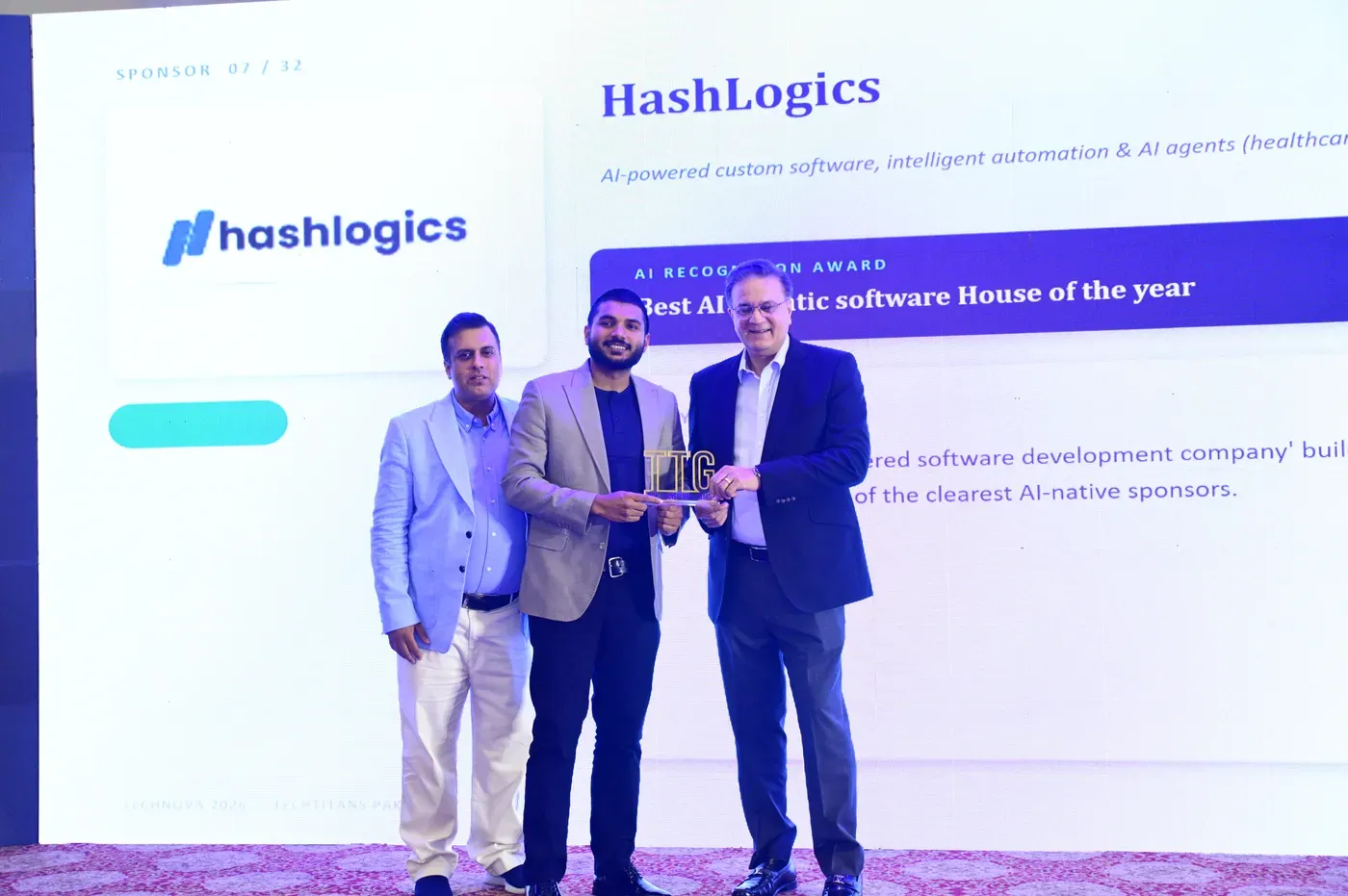
Abdul Basit founded Hashlogics in 2017, and the team runs from Lahore with a US LLC. Clients rate the work 4.8 on Clutch across 22 reviews, and in 2026 it was named Best AI-Native Software House of the Year at TechNova. TrialTriage, an AI clinical-trial matching system for oncology, is one of the systems we built and can show you.
Your audit call is with an engineer who has read call logs, schedules and denial reports like yours. Bring last month's numbers if you have them, and we'll work from those.
- BAA and NDA before the first conversation about real data.
- No pitch on the call. A note you could hand to another vendor.
- Fixed price per milestone from the Blueprint, so the number isn't a guess.
Go deeper
- AI, automation and custom software for practices →The whole chain, from the 4:50 call to the next visit.
- RCM automation for practices →Eligibility, verification, prior auth, clean claims and denials worked.
- Custom software for practices →Multi-location operations, dashboards, portal and patient communication.
- Epic integration: what a real build involves →FHIR, the developer programme, and what that means for your timeline.
- AI medical scribe: what it takes to chart into your EHR →Ambient documentation, your template, the clinician's signature.
- The EHR does 80% and people copy the rest →Where the manual work around the chart actually sits.
- HIPAA-compliant development →The PHI map, the BAA chain and how we build for regulated data.
