


Solar software for fleets nobody drives out to check
A panel losing 15% of its output for three weeks looks the same as a clean month on a bill that arrives late. The software either catches that gap or the installer eats it.
- 4.8 on Clutch across 22 reviews
- PremiumAudit.io: audit cycle cut 75%, calculation errors cut 95%
- In production for SmartREI, Tankaware, ZyloBase, KiwiWrite
What makes solar software different
4 things that decide this
- 01Your design tool's shading and production estimate is a promise, and your software has to reconcile it against what the site actually generates once it's live.
- 02Net metering isn't one rule for you. Credit rates, rollover terms and interconnection steps change by utility, sometimes inside the same state.
- 03Your ITC paperwork depends on installation and commissioning dates being correct and defensible, not just recorded.
- 04If your fleet is spread across hundreds of roofs, you need monitoring that tells a wiring fault apart from a cloudy week, or your alerts stop getting read.
The gap between the proposal and the invoice
A homeowner signs based on your design tool's shading model and production estimate. Then the site goes live, and three separate systems now have to agree: the inverter's telemetry, the utility's net-metering statement, and the bill the customer expects.
Most installers run these as three disconnected tools, so someone re-types numbers between them. If nobody checks your design estimate against real output, a system that underperforms by 15% looks fine, until a customer calls to ask why their bill went up.
TankAware is our IoT platform for a Canadian petroleum site operator. It watches unattended equipment across many locations. Sensor data has to be trusted before anyone acts on it, and an alert has to become an assigned job, not a notification nobody opens. Solar fleet monitoring is that same shape, applied to inverters instead of tank levels.
- 01Compare modeled output against actual production per site, not per fleet average.
- 02Keep net-metering rules in configuration per utility, not hardcoded per state.
- 03Timestamp commissioning the moment it happens.
Where we are useful
CRM through design-tool handoff
One record follows your lead from the first design-tool export through permitting, install and commissioning, instead of a spreadsheet that falls out of sync with the field.
Net-metering billing
We hold credit rates, rollover terms and true-up periods per utility, so a change in one territory doesn't silently apply everywhere else.
Fleet performance monitoring
We compare inverter and production data against each site's own expected output, built on the same IoT pipeline pattern we run in TankAware.
ITC and incentive documentation
We capture installation and commissioning dates at the point of work, with the photo and signature evidence your claim needs later.
- DesignShading model, estimated output.
- InstallCommissioning date and signer captured.
- SenseInverter telemetry streams in.
- CompareActual against modeled, per site.
- AlertUnderperformance flagged early.
- BillNet-metering math for this utility.
Skip step four and a failing string looks identical to a cloudy week until a customer notices their bill.
Underperformance hides inside an average
Your fleet dashboard showing total output across a hundred sites can look healthy while ten of those sites are still losing a fifth of their production. The fault only shows up when you compare each site against its own modeled baseline, not the fleet.
TankAware runs that same discipline for tank sensors. Judge a reading against what is normal for that specific site. Route the alert to whoever can actually act on it.
- Model expected output per site from its own design data, not a fleet-wide curve.
- Separate an inverter fault from a genuinely cloudy week before anyone gets paged.
- Track your hit rate, and retune the threshold when a flagged site turns out fine.
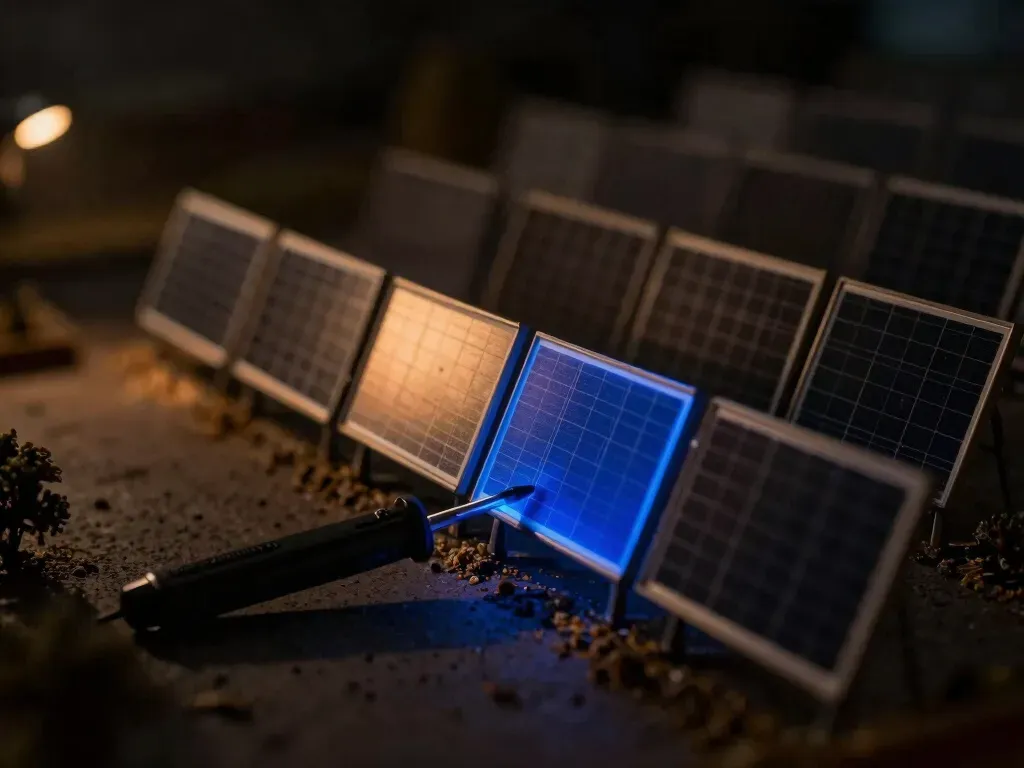
Unattended sites, monitored the same way
The stack this work runs on
Data and models
- IoT sensors
- Predictive alerting
- Anomaly detection
Platform
- React Native
- Vue.js
- PHP / Laravel
- AWS
Controls
- Multi-tenant isolation
- Role-based access
- Audit logs
Questions installers ask us first
01Can you connect to the inverter brands we already have in the field?+
We build the monitoring layer around whatever telemetry your inverters expose rather than requiring one brand. Name your makes and models early, since older units sometimes need a gateway to expose readings at all.
02How do you handle net metering when it differs by utility?+
Your credit rates, rollover terms and true-up periods live in configuration keyed to the utility, not in code keyed to the state. A territory change updates one record instead of a redeploy.
03Can software actually catch underperformance before a customer complains?+
Only if it compares each site's real output against its own modeled baseline, not a fleet average. A fault on one roof easily hides inside a hundred-site total until you build the per-site comparison in.
04What does the ITC paperwork actually need from the software?+
You need a commissioning date and signer captured at the point of work, with photo evidence attached, rather than typed in later from memory. Your record needs to hold up if the claim gets questioned months after install.
05How do you scope a solar software build?+
Scoping calls are free. Every build starts with a fixed-fee Blueprint: an engineer reads your real systems and writes the plan, with a fixed price for each milestone rather than a guess. The fee is credited in full against the build, and if the plan isn't one you'd act on, you don't pay for it. We won't put a schedule on it before we know how many inverter generations are in your fleet.
