

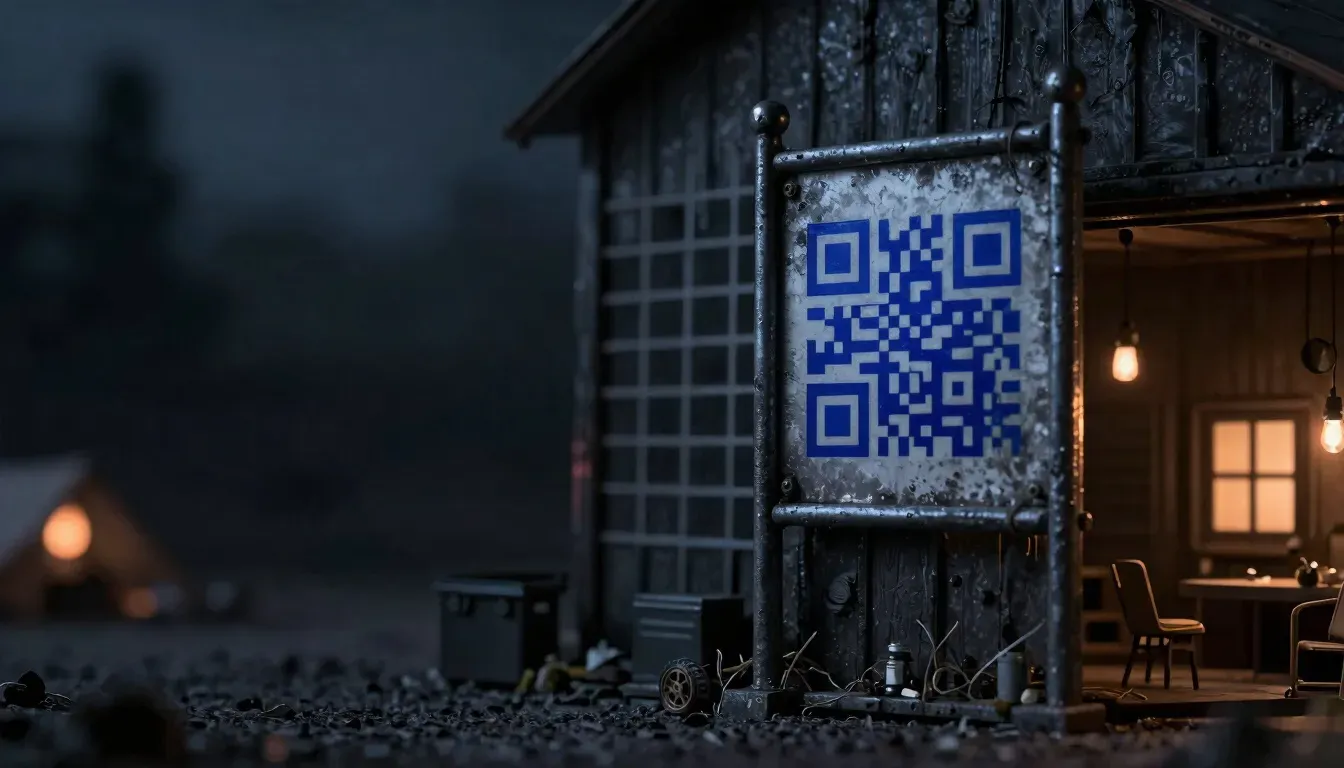
A QR code printed on a sign is a promise for its life
A QR code on a sign must work for the life of the sign, so guest software locks its URLs and redirects anything renamed.
Key takeaways
5 things that decide this
- 01A QR code printed on a sign has to keep working for the life of the sign, so guest software must lock its URLs, redirect anything renamed, and check on each scan that the property, site and marker are still active.
- 02A web page can change any day. A metal sign can't. The URL behind the code becomes a promise you can't take back.
- 03For Functional Fox, which supplies Smart Site Markers to RV parks and campgrounds, we built guest pages where park URL slugs are locked and admin renames are logged.
- 04Each scan checks that the customer, property, site and marker are active, and row-level security is forced on all 23 database tables so one park can never see another's data.
- 05The trade-off: permanence limits how far you can change your URL structure later.
Why doesn't metal update?
Most web software treats URLs as cheap. A team renames a page, restructures a site, or moves to a new platform, and old links quietly break. On the web that's an annoyance. People search again, or click from the new menu.
A QR code printed on a sign is different. Once it's etched, screwed to a post or set at a campsite, the URL inside it is fixed for the life of that sign. If the page behind it moves, every sign pointing at it is now broken, and the only fix is to reprint and reinstall. For a property with hundreds of markers, that's a real cost and a lot of labor.
So if you run hotels, parks or any property with printed codes, the software behind them carries a promise. Whatever happens to your brand, your platform or your page layout, that code has to land somewhere useful for as long as the sign stands.
Who did we build this for?
Functional Fox supplies solar-lit Smart Site Markers to RV parks and campgrounds. This is outdoor hospitality, not hotels. Hashlogics built Smart Site, the software the code opens: a guest page for every campsite, a park manager portal and an admin portal.
A guest scans the marker and gets the Wi-Fi password, check-out time and park rules for their exact site, with no app and no login. Each site page lists hookups, electric amps, maximum RV length and parking notes. Guests can report a maintenance issue from their site, and staff track it as new, in progress or done.
Thousands of signs had to run across many independent parks. That's what made URL permanence and data separation the core of the build, not extras.
How do locked slugs, logged renames and redirects work together?
The first rule is that the URL behind a printed code never depends on something people like to rename. In Smart Site, each marker carries a permanent QR URL. URL slugs are locked for parks, and admin renames are logged, so printed signs keep working.
The second rule covers the cases you can't avoid. Sometimes a path has to retire. When that happens, the old path redirects to the right place instead of returning an error. The permanent URL maps to one site, and retired paths redirect.
The third rule is about content, not addresses. Park managers edit in a draft-then-publish flow, so a change goes live on the next scan and no sign gets reprinted. The sign stays the same. What it shows can change every day.
- 01Lock the parts of the URL that appear on printed signs.
- 02Log every rename an admin makes, so you can trace what changed.
- 03Redirect retired paths instead of letting them fail.
- 04Change content through publishing, never by moving the URL.
- ScanA guest points a phone camera at the marker.
- ResolveThe permanent URL maps to one site. Retired paths redirect.
- CheckCustomer, property, site and marker must all be active.
- ServeOnly published content for that site and area comes back.
- RecordThe scan is saved with a time and a coarse device type.
If any check fails, the guest sees 'Site unavailable' instead of the wrong park's content.
What does every scan check?
A permanent URL alone isn't enough. If a park closes its account or a marker is removed, the old sign shouldn't keep showing live information. So when a guest scans a Smart Site marker, the platform checks four things: that the customer account, the property, the site and the marker are all active.
If any one of them isn't, the guest sees a plain 'Site unavailable' page. Suspending an account or deactivating a marker stops that content right away. Functional Fox provisions markers in batches of up to 1,000 and can suspend or reactivate accounts, so those four checks are what keep a large fleet of signs under control.
The scan itself is recorded with a time and a coarse device type. Scan analytics show top sites, areas, hours and device types without storing IP addresses or guest identifiers. Parks learn what guests look for, and nobody is tracked.
How do you stop one property seeing another's data?
Many parks run on one platform, and each one should only ever see its own sites, content and scans. Smart Site was built with the tenant rules first: customer, property, area, site, marker, scan.
The rules live in the database, not only in the app. Row-level security is forced on all 23 database tables, so the database decides who sees what. Anonymous visitors have zero direct table access. A park can't reach another park's data, even with a tampered URL or a direct API call, and park users can't raise their own privileges.
If you're buying a multi-tenant guest product for hotels or parks, this is the part to check first. We wrote more about proving it in multi-tenant AI needs isolation you can prove.
Which tests attack the rules?
Rules that only exist in a design document don't protect anyone. Smart Site has six suites holding 43 automated end-to-end tests, including tenant isolation, privilege escalation and sign permanence. The permanence suite exists so a future change can't quietly break the printed URLs.
Before handover, an internal security audit found three critical defects, and all three were fixed. That's the point of auditing your own build: the problems get found while they're still cheap to fix.
What does permanence cost later?
Permanence limits your later choices. You can't reorganize your URL structure freely once codes are printed, and every redirect you add is one more thing to keep working. Over years, those add up.
The way to live with it is to keep the printed part of the URL short and meaningless to people, so there's nothing anyone wants to rename. Put the meaning in the content behind it, where you can change it as often as you like. For more on what we build for properties, see our hospitality custom software page and our page for hotels.
Systems we have shipped
Count your printed codes before you change platforms
Before you rebuild a guest site or switch vendors, list every printed code on your property and the URL inside it. Those URLs are a requirement for the new system, not an afterthought.
If you want help building guest software that keeps them working, start with a 45-minute call. We then write a fixed-fee Blueprint from your real systems, credited in full against the build. See how we work.
What property operators ask
01Who builds custom software for hotels and campgrounds?+
Custom software firms build it, and the good ones design for printed codes, many properties and guest privacy from the start. Hashlogics built Smart Site for Functional Fox, the guest page and portals behind QR markers at RV parks and campgrounds, with permanent URLs, per-scan checks and database-level separation between parks.
02Do guests need an app to use a QR guest page?+
No. A guest points a phone camera at the code and the page opens in the browser. In Smart Site, nobody installs an app or signs in, and guests can copy the Wi-Fi password with one tap.
03How do you stop one property seeing another property's data?+
Put the rules in the database, not only in the app. Smart Site forces row-level security on all 23 tables, gives anonymous visitors no direct table access, and tests tenant isolation and privilege escalation in automated suites.
Related
- Custom software for hospitality →Guest, operations and portal builds for properties.
- Software for hotels →What hotels automate and build.
- Functional Fox case study →Permanent QR URLs and per-scan checks at RV parks and campgrounds.
- Multi-tenant AI needs isolation you can prove →How to show one tenant can't see another.
- Hospitality →The full hospitality hub.
- How we work →Call, fixed-fee Blueprint, fixed-price milestones.