

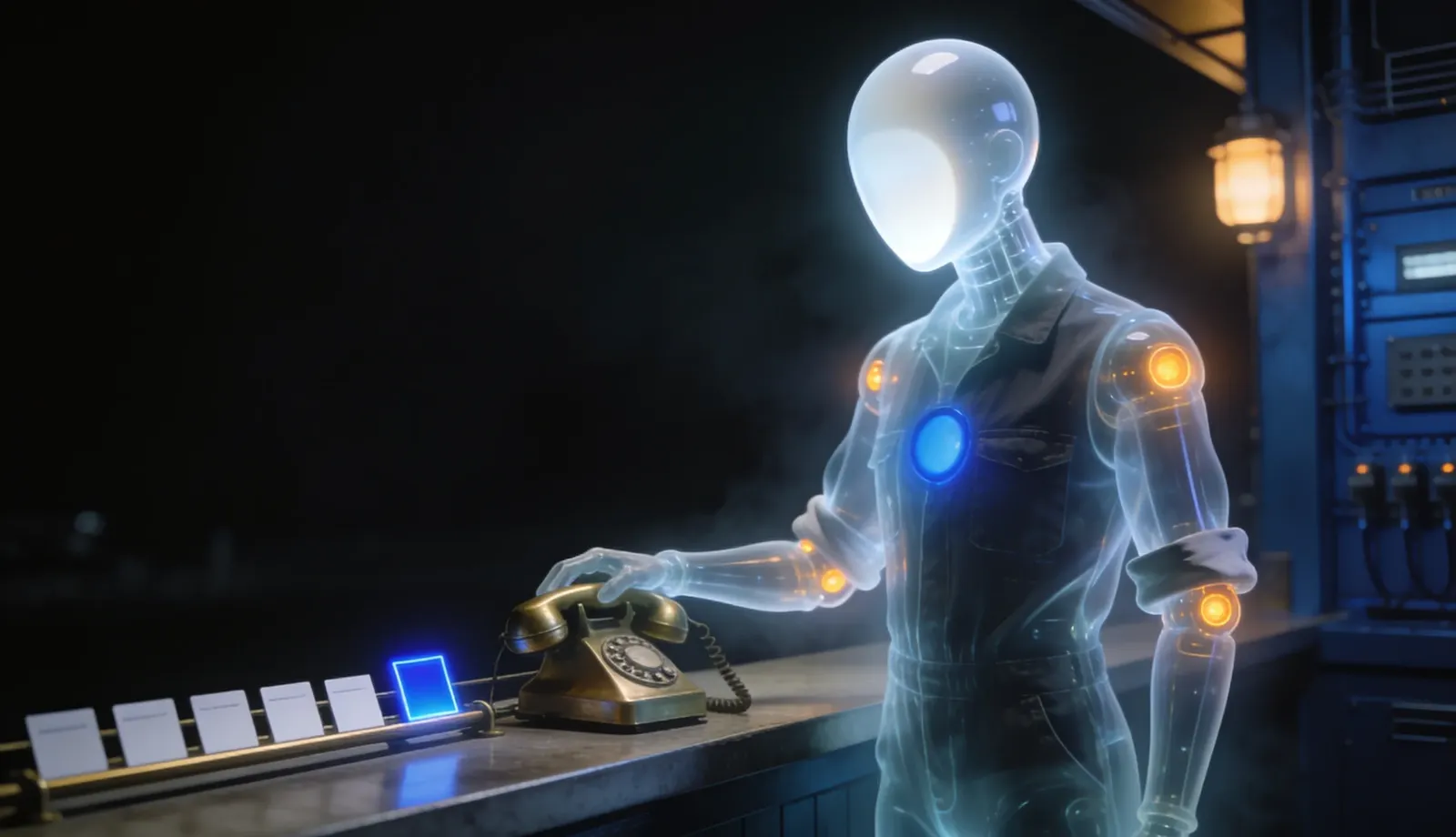
AI front counter for auto repair shops: the 8am call answered and booked, the 3pm status call answered from the RO
At 8am your advisor has three key drops in front of him and a phone ringing behind him, and one of them loses. Your line answers in two rings, asks what your best advisor would ask, captures name, vehicle, concern and the time they need it, books a real slot on your calendar and texts the confirmation.
- 4.8 on Clutch across 22 reviews
- PremiumAudit.io: audit cycle cut 75%, calculation errors cut 95%
- In production for SmartREI, Tankaware, ZyloBase, KiwiWrite
What you get
3 things that decide this
- 01Every ring answered through the drop-off rush, the lunch hour and after close, with the name, the vehicle, the concern and the time captured and the job booked into your own calendar instead of left on a message pad.
- 02Status answered from the live repair order, so the customer who calls every afternoon about a collision job on back-ordered parts hears the real stage without pulling your estimator off a supplement.
- 03A written hand-off rule your service manager can read: brakes, a fuel smell, a warning light with a noise, anyone who asks for a person. Your line recognises those and rings an advisor rather than handling them.
From the first ring to the pick-up text, and what each step writes back
These are the counter stations of the full shop workflow that the front-counter layer owns. Pick your shop system to see the write-back.
Station 01 · The 8am call
- Today
- Your counter is three deep with key drops, one advisor is doing write-ups, phone and cashier at once, and the call rolls to voicemail. That customer books with the shop that picked up.
- What we automate
- Your line answers in two rings, captures name, vehicle, concern and the time they need it, books into a real slot on your calendar, texts the confirmation, and hands to a person the moment the caller asks for one.
- What stays human
- Anything that sounds like a safety call, brakes gone, a smell of fuel, a warning light with a noise, goes straight to an advisor. It never says a car is safe to drive or a repair can wait.
Writes to TekmetricCustomer, vehicle and appointment on the calendar with the concern and the recording.
Station 02 · Is my car ready?
- Today
- Half the calls are status calls. On a collision job with parts on back order, the same customer calls every afternoon and the estimator answers every time.
- What we automate
- Stage-based status texts from live RO status: estimate, parts, body, paint, QC, ready. It answers "where's my car" from the same record, and only escalates when the answer isn't in it.
- What stays human
- Insurer, DRP and supplement conversations stay with the estimator. A delay the customer will be upset about is delivered by a person.
Writes to TekmetricCommunication log on the RO.
Station 03 · After hours and overflow
- Today
- Evenings and Saturdays roll to a machine, and the calls that arrive while both advisors are on the phone never reach anybody at all.
- What we automate
- That same line covers close of business, the weekend and the minutes your counter is saturated, booking the routine jobs and taking a structured note on anything it won't handle. Nothing waits for Monday to be re-keyed.
- What stays human
- Your service manager sets which job types it may book after hours, and a tow-in or a car that won't start reaches your on-call number rather than a queue.
Writes to TekmetricAppointment or a structured request on the customer record.
After the booking come the estimate, the parts and the invoice. The automotive hub walks the whole chain, and shop automation owns the middle of it.
Four things the front-counter layer does, and what it plugs into
Intake and booking that fills your calendar
Name, vehicle, concern and the time they need it, asked the way your best advisor asks. It books a real open slot against your bay capacity, texts the confirmation, and reads the appointment back before it hangs up. Marchex's call analytics across multi-location automotive service operators put unanswered or mishandled calls at up to a fifth, and the misses cluster exactly at drop-off and pick-up.
Status answered from the live repair order
"Is my car ready?" is answered from your RO, not from a note somebody left. The customer hears the stage the job is actually at, and if the answer isn't in the record the call goes to your advisor instead of guessing. Collision customers on a multi-week job get a text at each stage, so they stop calling to find out.
Hand-off rules you can read
Which words send a caller to a person immediately, which jobs it may book after hours, which vehicles it refuses. It's a table your service manager edits, not a prompt we hide, and we build and test it before the line takes a single live call. Drivability and safety are a technician's judgement and stay there.
Write-back into the system you already run
A booking means a customer, a vehicle and an appointment in Tekmetric, Shop-Ware, Shopmonkey, Mitchell 1, AutoLeap or whatever you run, with the concern and the recording attached. Access differs by system and by account, so we confirm yours during the audit. ZhoopZhoop booked into its own calendar for that reason, and any write-back into your system is scoped to your shop.
A staffed answering service and a template AI receptionist are good at what they were built for. Here's where a custom front counter starts.
An answering service staffed by people takes a decent message and is polite at 8pm. A template AI receptionist answers instantly and follows the script you picked from a menu. For a one-bay owner-operator who just needs the phone picked up, either is the right answer, and we'll tell you so on the audit call rather than sell you a build.
You outgrow them at three points. First comes intake: a message saying "call about a noise" isn't a booking, and somebody still has to ring back for the vehicle, the concern and a time. Second is status, because "is my car ready?" can only be answered honestly by something reading the live repair order. Third is scale, when several branches share one number and every caller has to land at the right counter. That last one is the ZhoopZhoop shape, and it's where we start.
- 01Intake that captures vehicle and concern into your calendar, not a message somebody re-keys.
- 02Status read off the live RO, with the escalation rule written down.
- 03One number across several branches, routed to the right counter and the right calendar.
Get a 2-minute demo call from our AI
Leave a mobile number. A person checks the request, then our AI calls you and plays your counter line. You're the 8:05am customer with a brake noise who needs it seen today; it asks what your advisor would ask and books you in. Then you call back at 3pm asking if it's ready, and it answers from the record. It texts you afterwards with what it would have written into your shop system.
No software declares a car safe, approves scope or quotes a finance term. We write that down first.
A shop's phone line and approval path sit under rules that don't bend for software: authorisation of repair work is a legal act the advisor owns, drivability and safety calls (brakes, airbags, ADAS calibrations) are always a technician's, recorded calls follow consent law, and texting follows opt-in. Dealerships add financing disclosure and Safeguards on top. So every build starts with a one-page map of what the software does, what it only proposes, and where a person signs.
What follows is simple to state, and we put it in writing. Your agent books, captures and reads back; it never says a car is safe or a repair can wait. Your advisor approves every estimate and every scope change. Nothing is written to a deal or a ledger without the person who owns it. And every automated touch is logged so you can show what was said, and when.
- 01Scope, price and safety stay with the advisor and the technician; the software captures and proposes.
- 02Consent on recorded calls and opt-in texting, by the rules of the state you're in.
- 03Recorded calls follow the consent law where you operate, including the two-party consent states, and your recordings stay yours.
“They will treat your vision like their own and build it that way.”
Ron Klabunde · Founder, SmartREI ↗
“They really help you understand the problem and deliver solutions in a short time frame.”
Johannes Peter · CEO, TomoDomo Coliving
Some of the systems we have shipped
- AuditFree. We read a month of your calls by hour and by outcome, count what share of them were status calls, and listen to how the line is answered today.
- DiagnoseWe map the path into your shop management system or DMS and sit at your front counter for a morning.
- BuildFixed price per milestone from the Blueprint. Tested on your real calls, real ROs and real parts orders, under NDA.
- RunMonitoring, a named engineer, and the first two months of maintenance free.
Best fit: three or more bays or more than one location, a front counter that's saturated, and a shop system you've outgrown in places. Not a fit yet: a one-bay owner-operator who needs the phone picked up, and we'll say so. You can stop after any stage; the audit note is yours either way.
Before you book
01Can an AI answer a repair shop's phone without making things worse?+
Yes, when it's built around your counter rather than configured from a menu. It captures name, vehicle, concern and the time they need it, books a real slot, texts the confirmation, and passes the call to a person the moment the caller asks. Marchex's analytics across multi-location automotive service operators put unanswered or mishandled calls at up to a fifth, so the honest comparison is not against your best advisor. It's against voicemail.
02What happens when somebody calls about brakes or a burning smell?+
An advisor takes that call. Safety triggers are a short list your service manager writes: brakes gone, a fuel or burning smell, smoke, a warning light with a noise or a vibration, a car that isn't drivable. Your line recognises them, says it's putting the caller through, and rings the number you set. It never tells a customer a car is safe to drive or that a repair can wait, because drivability is a technician's call.
03Will it really answer "is my car ready?"+
From the live repair order, yes. It reads the stage the job is at and says so, and where your system exposes it, the promised time as well. When the answer isn't in the record, or the customer is asking about a supplement or an insurer decision, it stops and hands to your estimator. Collision customers also get a text at each stage, which is what stops most of those calls happening at all.
04Do we have to record calls, and what about consent?+
Recording is your choice, and the rules follow the state you operate in. Some require every party on the call to consent, so your line announces the recording at the start where that applies, and we set the announcement per location rather than once for the whole group. Texting follows opt-in the same way. Your recordings and transcripts stay yours, retained on your schedule, and never used to train anything.
05We run four branches on one number. Can it handle that?+
That's the shape we built for ZhoopZhoop, a multi-branch auto repair group in Toronto. One line answers for every branch, asks which location the customer wants or works it out from the vehicle history, books into that branch's calendar, and routes the hand-off to that counter. A dashboard across branches sits on the custom software page, since it's the same integration layer underneath.
06Will it book straight into Tekmetric, Shop-Ware, Shopmonkey or Mitchell 1?+
To the depth your account exposes, and we confirm that during the audit instead of promising it on a call. These systems each have their own access model, some gated behind an application, and Mitchell 1, AutoLeap and the rest have their own routes again. Where the API stops we build a reviewed queue: your advisor accepts the booking with one click rather than re-typing it.
07We already use an answering service. Why change?+
Maybe don't. If your volume is low and the service takes a good message, keep it. Shops switch when the messages pile up and get called back after the customer booked elsewhere, when every message has to be re-keyed into the shop system anyway, or when status calls are eating the estimator's afternoon. Those are the three things a message service structurally can't fix.
A senior engineer, not a sales rep
Abdul Basit founded Hashlogics in 2017, and the team runs from Lahore with a US LLC. Clients rate the work 4.8 on Clutch across 22 reviews, and in 2026 it was named Best AI-Native Software House of the Year at TechNova. ZhoopZhoop, the AI platform for a multi-branch auto repair group in Toronto, is one of the systems we built and can show you.
Your audit call is with an engineer who has read call logs, RO histories and parts orders like yours. Bring last month's numbers if you have them, and we'll work from those.
- NDA before the first conversation.
- No pitch on the call. A note you could hand to another firm.
- Fixed price per milestone from the Blueprint, so the number isn't a guess.

Go deeper
- AI, automation and custom software for automotive →The whole chain, from the 8am call to the next oil change.
- Shop automation for auto repair →What happens after the booking: estimates, approvals, parts, follow-up.
- Custom software for automotive →Integration into your shop system, and the numbers by branch.
- Auto repair answering service vs AI receptionist →When a staffed service is enough, and when it isn't.
- How to stop "is my car ready?" calls →Stage texts from the RO, and the escalation rule.
- The 8am counter, three deep, and the phone won't stop →Where the misses cluster, and what to put in each one.
- ZhoopZhoop case study →The multi-branch auto repair build, in detail.
