

Custom software for auto repair groups and dealerships: integration into the system you run, and the numbers by branch
You have four systems and five logins, every integration between them carries a fee, and the report you actually want gets built by hand on a Saturday.
- 4.8 on Clutch across 22 reviews
- PremiumAudit.io: audit cycle cut 75%, calculation errors cut 95%
- In production for SmartREI, Tankaware, ZyloBase, KiwiWrite
What you get
3 things that decide this
- 01One integration layer instead of five point-to-point connections, designed around what your shop system or DMS account actually exposes rather than what a brochure claims it does.
- 02A read-only dashboard your general manager can open on a Monday: car count by source and hour, average repair order, hours per RO, approval rate on estimates, parts margin and gross profit by branch.
- 03An honest answer on build against buy, given on the free audit call before you have spent anything. Most single-location shops should buy a shop management system, and we tell them so.
From the systems you run to the numbers you trust, and what each step writes back
These are the stations underneath everything else on this hub. Pick your shop system to see what the layer reads and writes.
Station 01 · Integration into your shop system or DMS
- Today
- Four systems, five logins, and every connection between them has a fee attached. Somebody exports a spreadsheet on Friday so the numbers line up on Monday, and a certified programme sits between you and your own data.
- What we automate
- One layer that reads and writes through the shop management system's API where your account has one, through the DMS vendor's certified programme where that's the only route, through scheduled read-only extracts where neither exists, and through a queue your staff approve with a click where nothing else will do.
- What stays human
- Your controller signs anything that touches a deal or a ledger. We propose the write; a person with the authority commits it.
Writes to TekmetricAppointments, approvals and communication logs on the RO, to the depth your account exposes.
Station 02 · Multi-branch operations
- Today
- Each branch answers its own phone, keeps its own calendar and quotes its own parts, so a customer who calls the wrong location gets told to call another number, and no two branches run the day the same way.
- What we automate
- One line for the group routed to the right counter and the right calendar, outbound parts agents shared across branches, booking over WhatsApp or text, and one standard for how a job is written up. This is the ZhoopZhoop shape, and it booked into its own calendar because that was what the group's systems allowed.
- What stays human
- Each branch manager still runs their own shop floor. The layer makes the group consistent; it doesn't take the local decisions.
Writes to TekmetricBranch-scoped appointments and notes.
Station 03 · The owner's numbers
- Today
- Car count, average RO, hours per RO, gross profit by bay and by branch pulled by hand on Saturday from the shop system, the phone system and the accounting package.
- What we automate
- Dashboards across your shop system, phones and accounting: car count by source and hour, ARO, hours per RO, approval rate on estimates, parts margin, gross profit by branch, refreshed on a schedule, read-only.
- What stays human
- What to do about a branch that's losing money is your call. We make the number visible and trustworthy.
Writes to TekmetricRead-only. Nothing written back.
Your counter and your shop floor sit on top of this layer. The front-counter and shop-automation pages cover what runs there.
Four things we build at this layer, and what they plug into
The integration layer
Your shop management system's API where your account exposes one, the DMS vendor's certified programme where that is the only sanctioned route, scheduled read-only extracts where neither is available, and a reviewed queue where nothing else will do. Access differs by vendor and by account, and some of it is gated behind an application, so we confirm what yours allows during the audit instead of promising it beforehand.
The multi-branch dashboard
Car count by source and hour, average repair order, hours per RO, approval rate on estimates, parts margin, and gross profit by branch or rooftop, on one screen and refreshed on a schedule. It reads; it does not write. Owners we talk to have usually stopped trusting a number that took four exports and a formula to produce, and read-only is how it earns that trust back.
Booking over WhatsApp and text
Plenty of your customers would rather message than call, especially fleet contacts and the ones booking a second vehicle. We put the same intake behind a WhatsApp or text thread: vehicle, concern, time, confirmation, into the same calendar as the phone line. ZhoopZhoop runs this across its branches alongside the receptionist line.
An honest build-or-buy answer
Most single-location shops should buy a shop management system and stop there, and that is what we tell them on the audit call. We build when you run several branches on different systems, when the integration you need is priced out of reach or simply doesn't exist, or when the report you need spans systems that were never meant to talk.
Build or buy for shop software: most shops should buy, and here's the point where that changes.
Tekmetric, Shop-Ware, Shopmonkey, Mitchell 1, AutoLeap and the dealer systems are mature products with years of shop workflow in them, and no custom build we could write would match one on the basics. If you run a single location and your system does the write-up, the inspection, the invoice and the reporting you look at, buy it, configure it properly, and put the money into technicians instead.
Three things change that answer. Running several branches on different systems is the first, because you cannot get a group number out of two vendors who each report their own way, and consolidating on one system usually means retraining a branch that is perfectly happy. Second comes an integration priced out of reach or absent altogether, which is the ordinary state of affairs once a DMS certified programme is involved. Third is a report that spans systems, since car count lives in the shop system, the calls live in the phone system and the margin lives in accounting, and nobody sells the report that joins them.
- 01Several branches on different systems, reported one way.
- 02An integration your vendor prices out of reach, or never built.
- 03A number that only exists once three systems are joined.
No software declares a car safe, approves scope or quotes a finance term. We write that down first.
A shop's phone line and approval path sit under rules that don't bend for software: authorisation of repair work is a legal act the advisor owns, drivability and safety calls (brakes, airbags, ADAS calibrations) are always a technician's, recorded calls follow consent law, and texting follows opt-in. Dealerships add financing disclosure and Safeguards on top. So every build starts with a one-page map of what the software does, what it only proposes, and where a person signs.
What follows is simple to state, and we put it in writing. Your agent books, captures and reads back; it never says a car is safe or a repair can wait. Your advisor approves every estimate and every scope change. Nothing is written to a deal or a ledger without the person who owns it. And every automated touch is logged so you can show what was said, and when.
- 01Scope, price and safety stay with the advisor and the technician; the software captures and proposes.
- 02Consent on recorded calls and opt-in texting, by the rules of the state you're in.
- 03Your controller signs anything written to a deal or a ledger, and the reporting layer stays read-only.
“They will treat your vision like their own and build it that way.”
Ron Klabunde · Founder, SmartREI ↗
“They really help you understand the problem and deliver solutions in a short time frame.”
Johannes Peter · CEO, TomoDomo Coliving
Some of the systems we have shipped
- AuditFree. We map which systems hold which numbers, what each account actually exposes, and which of the reports you build by hand could come off a schedule instead.
- DiagnoseWe map the path into your shop management system or DMS and sit at your front counter for a morning.
- BuildFixed price per milestone from the Blueprint. Tested on your real calls, real ROs and real parts orders, under NDA.
- RunMonitoring, a named engineer, and the first two months of maintenance free.
Best fit: three or more bays or more than one location, a front counter that's saturated, and a shop system you've outgrown in places. Not a fit yet: a one-bay owner-operator who needs the phone picked up, and we'll say so. You can stop after any stage; the audit note is yours either way.
Before you book
01Should we build custom software or buy a shop management system?+
Buy, if you run one location and the system covers your write-up, inspection, invoice and reporting. We say that on audit calls regularly and we mean it. Building makes sense when you run several branches on different systems, when the integration you need is priced out of reach or was never built, or when the report you need spans your shop system, your phones and your accounting package.
02Can you integrate with Tekmetric, Shop-Ware, Shopmonkey or Mitchell 1?+
To the depth your account exposes, and we confirm that during the audit rather than promising it on a call. Some of these publish an API that your account has to be approved for, and approval is not automatic. Mitchell 1, AutoLeap and the collision systems each have their own routes again. Where the API stops, we build a reviewed queue your staff accept with one click instead of re-typing.
03What about a DMS like CDK, Reynolds or Dealertrack?+
Those run certified integration programmes, and the sanctioned route is through them. It carries fees and a review process, so the honest sequence is to find out what your store's agreement allows before anybody designs around it. Where the certified route is closed or priced beyond what the job is worth, we work from scheduled extracts and a reviewed queue, and your controller signs anything that touches a deal or a ledger.
04Will the dashboard write back into our systems?+
No, and that's deliberate. Reporting stays read-only, so a bad query can never change a repair order or a ledger entry. Car count, average RO, hours per RO, approval rate, parts margin and gross profit by branch are read on a schedule and shown on one screen. Where a write is genuinely needed, it happens through the integration layer with a named person approving it.
05We run four branches on different systems. Is that a problem?+
It's the reason most groups call us. Each branch keeps the system its team knows, and the layer normalises what comes out so the group numbers mean the same thing everywhere. ZhoopZhoop, a multi-branch auto repair group in Toronto, is built this way: one receptionist line across branches, shared outbound parts agents, WhatsApp booking and a dashboard over the top.
06Do you replace our shop system?+
Almost never, and we would argue against it. Your team knows the system, your history sits in it, and a migration costs you weeks of shop floor time before it returns anything. We build the layer around it and leave it as the record. One exception: a system so old that nothing can read it, and even then we would show you the evidence before recommending a move.
07Who owns the code and the data?+
You do, on both counts. The build is yours, the repository is handed over, and your customer and vehicle data stays in your systems and your accounts. We work under NDA from the first conversation, the first two months of maintenance after launch are included, and after that you either keep us on support or take it in-house with your engineers trained on it.
A senior engineer, not a sales rep
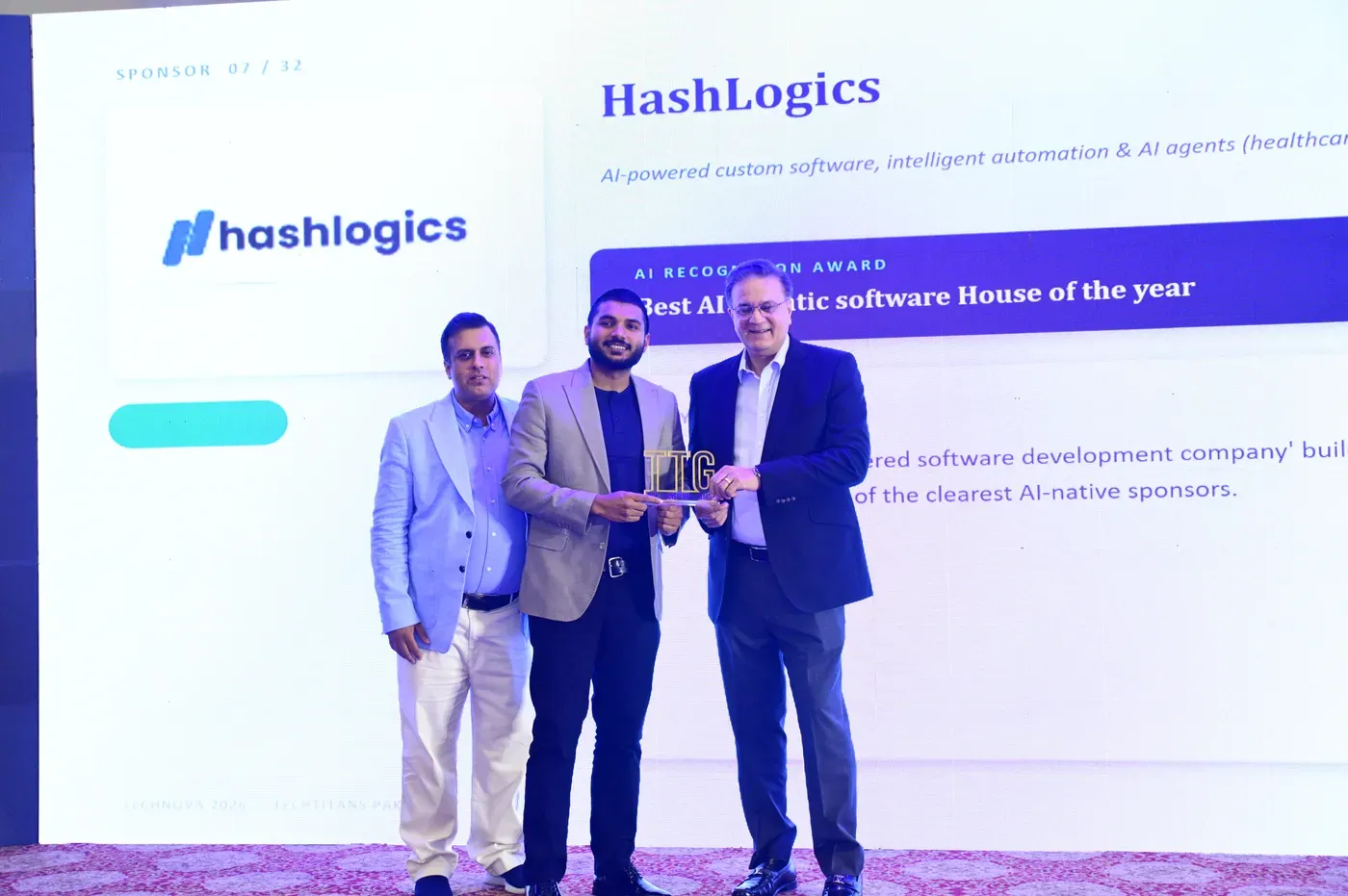
Abdul Basit founded Hashlogics in 2017, and the team runs from Lahore with a US LLC. Clients rate the work 4.8 on Clutch across 22 reviews, and in 2026 it was named Best AI-Native Software House of the Year at TechNova. ZhoopZhoop, the AI platform for a multi-branch auto repair group in Toronto, is one of the systems we built and can show you.
Your audit call is with an engineer who has read call logs, RO histories and parts orders like yours. Bring last month's numbers if you have them, and we'll work from those.
- NDA before the first conversation.
- No pitch on the call. A note you could hand to another firm.
- Fixed price per milestone from the Blueprint, so the number isn't a guess.
Go deeper
- AI, automation and custom software for automotive →The whole chain, from the 8am call to the next oil change.
- AI front counter for auto repair →The 8am call and the 3pm status call, answered and booked.
- Shop automation for auto repair →Estimates, approvals, status texts, parts quotes, follow-up.
- AI and automation for dealerships →Service lane, BDC, deal jacket, retention, DMS access.
- Tekmetric, Shopmonkey and Shop-Ware APIs: what a real integration involves →What each exposes, and what that means for a build.
- Best auto repair shop software →An honest roundup, with us last as the layer on top.
- ZhoopZhoop case study →The multi-branch auto repair build, in detail.
