


AI, automation and custom software for medical clinics, built around the EHR you already run
You keep athenahealth, eClinicalWorks, Epic, NextGen or whatever your group runs. We build the layer it never gave you. Prior-auth packets get built from the chart and chased to a decision. Coverage is checked before the patient arrives, and intake lands in the record without anyone re-keying it.
- 4.8 on Clutch across 22 reviews
- PremiumAudit.io: audit cycle cut 75%, calculation errors cut 95%
- In production for SmartREI, Tankaware, ZyloBase, KiwiWrite
What changes for your clinic
3 things that decide this
- 01Practices average roughly 40 prior auths per physician a week, and about 13 staff hours go into the phone and fax work behind them (Rivet Health, athenahealth). We build the packet from the chart, send it, chase the payer, and put your people on the exceptions instead of on hold.
- 02Your front desk types the same details three times, because intake, coverage and the chart don't talk to each other. We wire intake straight into the record, run the coverage check before the visit, and let your staff fix what the software flags rather than key what it already has.
- 03Everything around the visit runs the same way. Every site answers the phone by one set of rules, reminders and recall actually go out, and notes get drafted into your own template for a clinician to sign. Claims are scrubbed before they leave, and one view pulls the EHR, the clearinghouse and your accounting system together.
Eight places a clinic leaks staff hours, and what we put in each one
These are the eight areas our audits keep finding, in the order a patient meets them. Each one links to the page that owns it.
Be the clinic that answers. Book the new patient.
A new patient calls at ten to five while your desk is checking someone out, and they book with whoever picks up. Your line answers instead, asks your screening questions by visit type, checks the basics of coverage, and books into your real schedule with the right provider. Anything clinical or urgent goes to a person mid-sentence.
AI front desk for practices →
Empty slots backfilled. Recall that runs across every site.
No-show rates sit in the teens for most practices, and recall lists never get worked once you have more than one location. We build reminder and confirmation sequences by appointment type, backfill an open slot from the waitlist, and run recall and reactivation from records you already hold, the same way at every site.
How to reduce no-shows with automation →
Prior auth done without 13 hours of faxing.
About 40 prior auths per physician a week, most of it phone and fax, and 90% of doctors say the delays affect care (Rivet Health, athenahealth). We build the packet from the chart against the payer's own rules, send it, track it to a decision, and hand the exception to a person with the history attached.
How to automate prior authorization →
Chart once. Type nothing twice.
Your EHR does 80% of the job and people copy the other 20% between systems. We build the missing part. Intake goes into the chart without re-keying, ambient notes get drafted into your own template for a clinician to sign, and we make the FHIR, HL7 or vendor-API connections your EHR vendor was never going to build for you.
EHR integration for practices →
Clean claims out. Denials worked. Balances collected.
Claims leave late, denials get worked when someone has time, and patient balances age quietly past 90 days. We scrub claims against payer rules before submission, sort denials into a work queue by reason and dollar, and send statements with a payment link on a schedule. Your billing staff post the payments; the software stays read-only on the ledger.
RCM automation for practices →
Same standard at every location, without hiring for it.
Every site answers the phone differently, runs recall differently, and holds its standard work in one long-serving person's head. We put that standard into software instead: one phone brain, one set of recall rules, one intake flow, and dashboards by site so your director of operations can see which one has drifted.
Custom software for practices →
Know which service line, which payer and which site make money.
Visit volume lives in the EHR, the aging report lives in the clearinghouse, payroll lives somewhere else, and the three disagree. We build a read-only dashboard across all of them: encounters and collections by provider and site, schedule utilisation, no-show rate, new-patient conversion by source, denial rate by payer.
Which practice KPIs actually matter →
Patients who know what's next, and come back.
People call your desk to ask about results, a form or a balance, and each of those calls costs you a booking. Two-way messaging off the record handles them: forms before the visit, results-ready notices, the balance with a link to pay, directions to the right site, and reactivation for the patient nobody has seen in two years.
Medical answering service vs AI receptionist →
From the new-patient call to the payer's decision, and where the machine takes over
Three stations where a multi-site medical group is different from a single-chair practice. Pick your system to see what each step writes back. Elation, Practice Fusion, Cerner and the rest follow the same pattern, to the depth their access model allows.
Station 01 · The 4:50 call, at whichever site picks up
- Today
- A new patient calls your busiest location at ten to five. It rings out or lands in a voicemail box nobody clears until Tuesday, and the referral you paid for books somewhere else.
- What we automate
- Your line answers in two rings at every site and asks the screening questions you wrote for that visit type. It works out which site and which provider fit, checks the basics of coverage, and books a real open slot.
- What stays human
- Chest pain, difficulty breathing, a caller in distress or anything a triage nurse should hear goes to a person before the sentence ends. You write that trigger list; we build and test it first.
Writes to athenahealthPatient and appointment created, with the call notes and the recording attached.
Station 02 · Intake, before anyone re-keys it
- Today
- Your front desk hands over a clipboard and types the details into the EHR. Then the same insurance numbers get keyed into the payer portal, and again into billing. Three passes, three chances to fumble a policy number.
- What we automate
- Your patient fills in intake on their phone before the visit. Name, history, consents and the card images go into the chart once. Your coverage check runs off that same data, and the answer lands on the visit.
- What stays human
- Your staff see only what didn't match: the policy that terminated, the name spelled two ways, the consent nobody signed. They fix those and move on instead of typing the ones that were already right.
Writes to athenahealthDemographics, insurance and consents written to the patient chart; coverage on the encounter.
Station 03 · Prior auth, from the chart to the decision
- Today
- Your medical assistant pulls the notes, finds the payer's form, faxes it, then rings to ask where it went. Roughly 13 staff hours a week per physician go into that loop, and your patient waits.
- What we automate
- We build the packet from the chart against that payer's own rules: the notes, the imaging report, the therapy that failed, the CPT and ICD codes. It goes out by payer portal or clearinghouse, and we poll the status until an answer comes back.
- What stays human
- Your clinician signs anything clinical. A person takes every exception too: the peer-to-peer call, the denial that needs an appeal, the rules that genuinely don't fit. Nothing goes out that a human hasn't approved.
Writes to athenahealthAuthorisation number, status and expiry written back to the order and the encounter.
Each station links to the page that owns it, and the rest of the chain sits on the healthcare hub. Every clinical decision stays with a clinician.
We don't replace athenahealth, Epic, eClinicalWorks, NextGen or whatever your group runs. We build what they won't.
Your EHR is the legal record, your clinicians know where everything lives in it, and moving off it costs more than the gaps it closes. Those gaps look the same in every group we talk to: a call nobody answered, a prior auth chased by phone, patient details typed three times, and a report your administrator rebuilds in a spreadsheet every month.
What decides the build is the access model, not the logo. athenahealth runs a marketplace and API programme. eClinicalWorks and NextGen expose vendor APIs, and Epic works through FHIR endpoints plus a vendor programme your group has to sponsor. Elation, Practice Fusion and Cerner each have their own way in. We check what your account exposes during the audit and design to it. Where the interface stops, your staff accept a reviewed queue with one click rather than re-type it.
One more thing we plan for that most projects skip: interfaces drift. A payer rewrites a rules document, a vendor drops an endpoint, an upgrade moves a field. We watch the shape of what we read and write, so a change shows up as an alert on a Tuesday morning. Otherwise you lose a month of auths nobody can find.
- 01Appointment, demographics, intake and authorisation write-back into your EHR, with the source document attached.
- 02Your EHR stays the chart. We draft into it, and a clinician signs.
- 03Payments are posted by your billing staff, never by the software.
Where patient information travels is the first design decision, made on paper, with your compliance officer
Most practices we talk to have had an AI tool vetoed by compliance, and the veto was usually right: the vendor couldn't say where the data went, wouldn't sign a BAA that covered every party in the chain, or trained on inputs. So every build starts with a one-page PHI map: which system holds what, which vendor touches it, which region, what's logged, what's retained, and which fields get de-identified before a model ever sees them.
What follows is simple to state, and we put it in writing. A BAA with every business associate in the chain before any PHI moves. Access scoped to the role and the patient, never practice-wide. No training on your data. An audit trail of who saw what. And the clinical decision, the diagnosis and anything that touches care stays with a clinician; the software schedules, verifies, drafts and reminds.
- 01BAA with every vendor in the chain, signed before anything is built.
- 02PHI scoped to role and patient; de-identified where a model is involved; audit trail on every access.
- 03Prior-auth packets and intake carry PHI end to end, so every clearinghouse, payer portal and model in the chain sits under a BAA and a written retention rule.
“They will treat your vision like their own and build it that way.”
Ron Klabunde · Founder, SmartREI ↗
“I am extremely happy with the results and would highly recommend Hashlogics to anyone.”
Daniel Khin · CEO, PremiumAudit.io
Some of the systems we have shipped
- AuditFree. We count your prior-auth volume and the staff hours behind it, follow the intake and coverage path, and look at recall and no-show follow-up per site. Then we list the manual work sitting around your EHR. That's the Practice Operations Audit, and the one-page note is yours either way.
- DiagnoseWe map the path into your EHR or PMS, sit with your front desk and billing for an afternoon, and write the PHI map.
- BuildFixed price per milestone from the Blueprint. BAA signed first. Tested on your real schedule and real claims, de-identified where it should be.
- RunMonitoring, a named engineer, and the first two months of maintenance free.
Best fit: a practice or group with two or more providers, a front desk that's saturated, and an EHR or PMS you've outgrown in places. Not a fit yet: a solo provider who needs the phone picked up, and we'll say so. You can stop after any stage; the audit note is yours either way.
Before you book
01Can you integrate with Epic, athenahealth or eClinicalWorks?+
To the depth your account exposes, and we confirm which during the audit rather than promising first. athenahealth runs a marketplace and API programme. eClinicalWorks and NextGen publish vendor APIs, and Epic works through FHIR endpoints plus a vendor programme your group sponsors. That sponsorship is a real timeline item, not a formality. Where an interface genuinely stops, your staff accept a reviewed queue with one click, so nobody re-types a patient record.
02Is a clinic AI receptionist HIPAA compliant?+
Our architecture is, and we put it in writing before anything is built. A BAA with every vendor in the chain. PHI scoped to role and patient, de-identified where a model is involved, and never used to train one. An audit trail of every access, and a one-page map of where patient data travels that your compliance officer signs. HIPAA doesn't certify software. It makes you responsible for how it's built, which is why we show you the map.
03How much of prior authorisation can actually be automated?+
Building the packet, sending it and chasing it, which is where those 13 staff hours a week per physician go (Rivet Health). Software pulls the notes, the imaging report and the codes, checks them against the payer's own rules, sends it through the portal or clearinghouse, and polls for a decision. Your clinician signs anything clinical, and a person takes the peer-to-peer call and the appeal. Payers behave differently enough that we scope on your own volumes, not a headline percentage.
04Will this replace our front desk or our medical assistants?+
It takes the phone and the fax off them. Most groups we talk to aren't trying to cut roles. They're trying to stop losing the people they have to work nobody trained for. Your MA moves from hold music to the patients in the building, and your front desk gets to look up when someone walks in.
05We run several locations on different EHR versions. Can you give us one operations view?+
Yes, and the version drift is exactly why a live query across every site fails. We pull each location on a schedule into one shared model, then report from that. Visits and collections by provider and site, how full the schedule runs, no-show rate, denial rate by payer, prior-auth turnaround. Your numbers agree because they all come from one pipeline, and the dashboard is read-only.
06Is this the whole of what you do for medical clinics?+
No. Prior auth and the phone are the loudest problems, so that is usually where we start. Our same team builds the intake and notes into the chart, the claim scrubbing and denial queues, the dashboards across your sites, the patient portal your EHR doesn't give you, and custom software where nothing off the shelf fits. Our healthcare hub lays out all eight areas and which page owns each one.
A senior engineer, not a sales rep
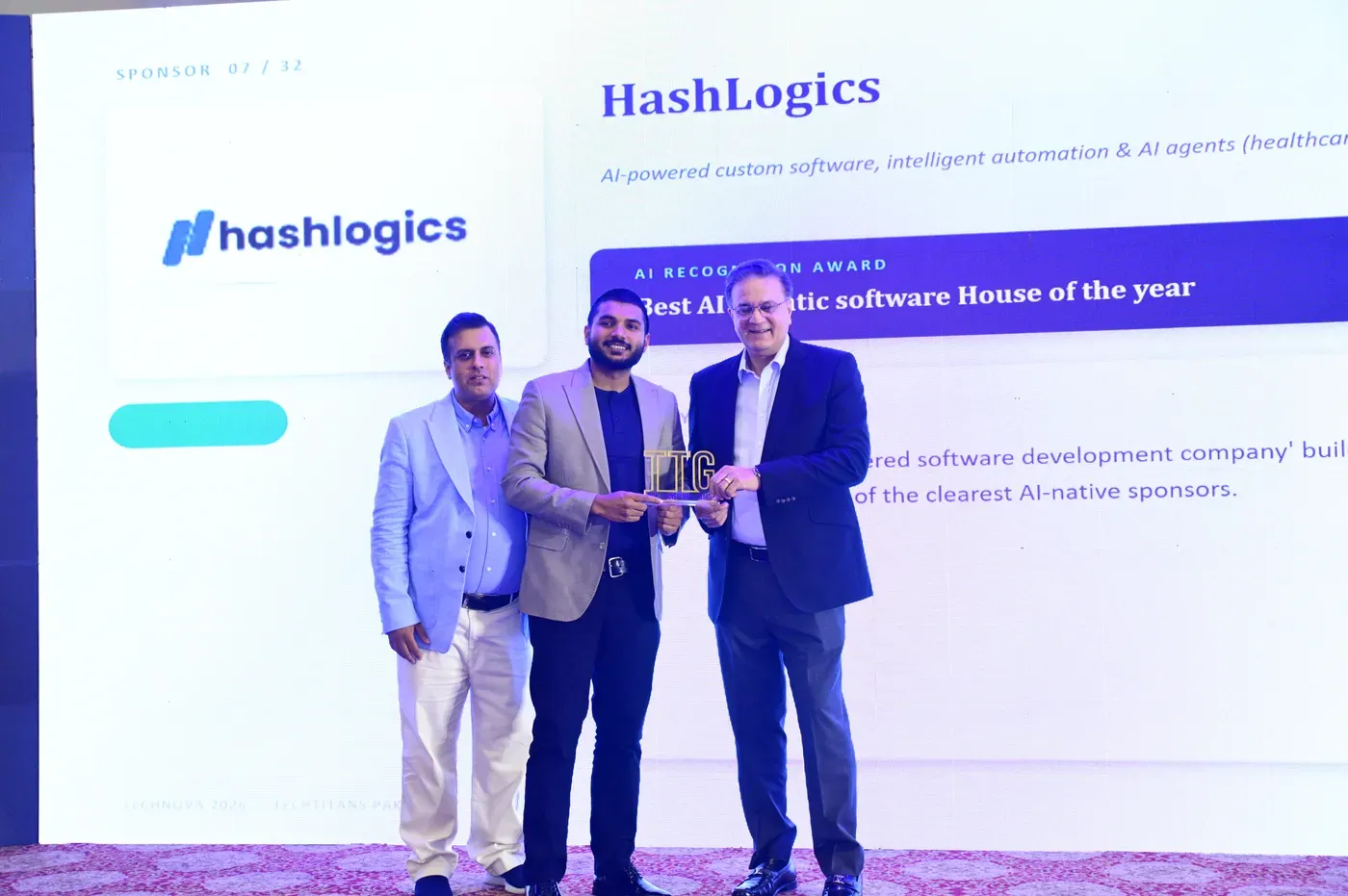
Abdul Basit founded Hashlogics in 2017, and the team runs from Lahore with a US LLC. Clients rate the work 4.8 on Clutch across 22 reviews, and in 2026 it was named Best AI-Native Software House of the Year at TechNova. TrialTriage, an AI clinical-trial matching system for oncology, is one of the systems we built and can show you.
Your audit call is with an engineer who has read call logs, schedules and denial reports like yours. Bring last month's numbers if you have them, and we'll work from those.
- BAA and NDA before the first conversation about real data.
- No pitch on the call. A note you could hand to another vendor.
- Fixed price per milestone from the Blueprint, so the number isn't a guess.
More for medical clinics
- AI, automation and custom software for practices →The whole chain across medical, dental and veterinary, and which page owns each part.
- AI front desk for practices →The 4:50 call answered, screened and booked into your schedule.
- RCM automation for practices →Eligibility, verification, clean claims and denials worked by reason and dollar.
- EHR integration for practices →FHIR, HL7 and vendor APIs, and what your own account actually exposes.
- Custom software for practices →Multi-location operations, dashboards, portal and patient communication.
- HIPAA-compliant development →The PHI map, the BAA chain and how we build for regulated data.
- Best medical answering services for clinics →Human and AI services ranked, with the custom build last and its trade-off stated.
- Medical answering service vs AI receptionist →The verdict first, then the conditions each one wins under.
- How to automate prior authorization →From the chart to the payer decision, with a person on every exception.
- Epic integration: what a real build involves →FHIR, the vendor programme, and what that means for your timeline.
- The 4:50 call: the new patient nobody called back →What one week of call logs shows about the hour your bookings go missing.
