


Custom software for oil and gas: vendor portals, multi-tenant separation and the record across every site
You already have a fuel ERP, a production system and an operator's portal, and none of them is the problem. What falls between them is. The deficiency nobody owns. The contractor who can't be given a login. We build that layer, to the depth your systems actually expose.
- 4.8 on Clutch across 22 reviews
- PremiumAudit.io: audit cycle cut 75%, calculation errors cut 95%
- In production for SmartREI, Tankaware, ZyloBase, KiwiWrite
What you get from a build here
3 things that decide this
- 01A compliance record is worth exactly what its audit trail proves. If an inspection can be edited afterwards with no trace, it won't hold up when somebody asks who did what and when. So the strongest thing software does here is dull work: a timestamped, signed, photo-backed record that nobody can quietly change, and which shows you the sites that were missed as readily as the ones that were done.
- 02Every party sees only theirs. TankAware runs five permission tiers, with each client organisation isolated under its own subdomain, so your contractor sees his sites and nobody else's. Getting that boundary wrong is a breach question rather than a bug, which is why it belongs at the beginning of a build rather than in a later phase.
- 03The integration depth gets settled before the software is scoped. Enverus OpenInvoice dictates a format. Quorum, P2 and WellView expose data to different depths, and ATG vendors publish their own feeds. Hardware in a hazardous area narrows your device options long before price does.
From a deficiency to the numbers your board reads, and where the machine takes over
Three stations of a multi-site operator's month. Pick the system you'd want written to; your fuel ERP, P2, WellView and the rest follow the same pattern to the depth their access model allows.
Station 01 · The numbers across sites
- Today
- Your sites, tanks, inspections, deliveries and variance sit in a spreadsheet per site, compiled by hand for your board and the regulator.
- What we automate
- Dashboards across sites and systems, compliance and environmental reports generated from the record, and multi-tenant separation so a client, a division or a contractor sees only theirs.
- What stays human
- What to do about a site that's losing money or missing inspections is your call. We make it visible and trustworthy.
Writes to Enverus OpenInvoiceRead-only.
Station 02 · Vendors, contractors and work orders
- Today
- You email a contractor about a deficiency, he does the work, and you find out three weeks later. Meanwhile the deficiency is past its due date, which is its own compliance exposure.
- What we automate
- A vendor portal where a deficiency becomes an assigned work order with a due date. Your contractor uploads evidence of completion, and payment runs through the same lifecycle where you want it there.
- What stays human
- You decide what's a deficiency and who fixes it. Your contractor still does the work and signs for it.
Writes to Enverus OpenInvoiceContractor invoice submitted where your operator's portal takes one.
Station 03 · Integration into what you run
- Today
- Your fuel ERP, your production system and your operator's portal each hold a piece of the same job. Somebody spends their week as a human adapter between them.
- What we automate
- One integration layer per system, built to what each actually exposes. Format mapping for the operator's portal. Read and write depth for your production system, the ATG vendor feeds, and your ledger. Offline-first everywhere your people work.
- What stays human
- Your system of record stays the system of record and wins any conflict. Where an API stops, your staff accept a reviewed queue with one click.
Writes to Enverus OpenInvoiceInvoices and attachments in the operator's required format.
Your system of record stays the system of record. What we build spans them and never overrules them.
Four things we build when the packaged system runs out
Four builds we do repeatedly in this vertical, all four of them running in TankAware today.
Vendor and contractor portal, deficiency to close-out
The deficiency-to-work-order loop crosses a company line, which is why email swallows it. We build your contractors their own access, with an assigned work order, a due date, photo evidence of completion and integrated payments where you want them. So a deficiency has an owner and an end, rather than a place in somebody's inbox. One that sits past its due date is its own compliance exposure.
Multi-tenant separation that holds up
Your natural user set spans you, your sites, your contractors and sometimes your customers, each needing different visibility. TankAware runs five permission tiers with per-organisation isolation under dedicated subdomains. Designing for one organisation and scaling later is the migration nobody enjoys. Getting the boundary wrong isn't a bug you patch on a Friday, so this decision belongs on day one.
Dashboards, compliance and environmental reporting
Every agency wants the same numbers in a different format on a different date, and the data lives in five systems. So somebody spends days assembling it each cycle. We build the single data layer first, then generate the reports off the record. Retention is modelled per record type rather than as one global timer, because the types run on different clocks and some are counted by event rather than by date.
The integration layer, offline-first
We map to what each system actually exposes. The format Enverus OpenInvoice requires. The read and write depth your Quorum, P2 or WellView instance allows. The feed your ATG vendor publishes, and whatever your accountant lets QuickBooks accept. Your sites with no signal capture offline and sync with the original time intact. Where an API stops, your staff accept a reviewed queue with one click rather than re-keying it.
Build the part nobody sells you. Buy everything else, and we'll say which is which.
A custom build is the wrong answer more often than agencies admit. Your fuel ERP, your production system and your accounting were each built for a job by people who've watched a thousand operators do it. Rebuilding any of them is a way to spend a year arriving where you started. Pricing and route planning are their own products rather than features, and we say so on the call.
What nobody sells you is the shape of your own operation. Which sites belong to which client. Which contractor may see which asset. What your state's implementing agency wants in a report, and on which date. How a deficiency found on a Tuesday reaches the person who fixes it by Friday. That part is specific to you, it's where the packaged systems hand you a spreadsheet, and it's what we build.
So the honest test is whether the gap has a product in it. If it does, buy the product and we'll help you integrate it. If the gap is the joins between your systems, the boundaries between your organisations, or a record that has to survive an audit, that's a build. We scope it against what your systems expose, never against what a brochure claims.
- 01Pricing, route optimisation and accounting are products. Buy them.
- 02Your org boundaries, your deficiency lifecycle and your audit record are yours. Those we build.
- 03Rules differ by jurisdiction, so retention and inspection intervals stay in configuration, never in code.
Software on top of a certified detection method, never instead of it. We write that down first.
Fuel and oilfield operations sit under rules that don't bend for software: release detection has to meet the performance standards in 40 CFR 280 and be certified as a method, the 30-day walkthrough record is the compliance artefact whether or not the inspection happened, and a field ticket is a billing document an operator will audit. So every build starts with a one-page map of what the software records, what it only proposes, and where a person signs.
What follows is simple to state, and we put it in writing. We triage, de-duplicate and escalate alarms from your certified method; we never claim to be the method. Every inspection record is timestamped, photo-backed and immutable, and a gap stays visible as a gap. Tickets and invoices are approved by a person before they go to an operator's portal. And every automated touch is logged so an inspector or an auditor can read what happened, and when.
- 01Release detection stays with the certified method; we add triage, escalation and the record.
- 02Inspection records immutable and gap-honest; tickets and invoices approved by a person.
- 03Multi-tenant boundaries and retention rules are decided on day one, in writing, because both are breach questions rather than settings.
“They will treat your vision like their own and build it that way.”
Ron Klabunde · Founder, SmartREI ↗
“TankAware has revolutionized how we manage petroleum sites. The real-time data and automation have exceeded expectations.”
Blake Sutherland · President, Sutherland Excavating Ltd.
Some of the systems we have shipped
- AuditFree. We map what your ERP, ATG feeds and operator portals actually expose. Then we read how your reports get assembled today, and who currently sees what across your organisations.
- DiagnoseWe map the path into your ERP, ATG feeds and operator portals, and ride along on a site round or a ticket's journey.
- BuildFixed price per milestone from the Blueprint. Tested on your real sites, real tickets and real alarms, offline-first, under NDA.
- RunMonitoring, a named engineer, and the first two months of maintenance free.
Best fit: ten or more sites or trucks, or an oilfield services company with a ticket-to-cash problem, and systems you've outgrown in places. Not a fit yet: a single-site operator who needs a sensor and a text, and we'll say so. You can stop after any stage; the audit note is yours either way.
Before you book
01Should we build or buy?+
Buy wherever a product exists for the job, and we'll name the products. Pricing, route optimisation and core accounting are their own markets, and rebuilding them is a year spent arriving where you started. Build where the gap is your own shape. Which client owns which site. Which contractor may see which asset. What your agency wants in a report, and how a deficiency reaches the person who fixes it. That part nobody sells you.
02What did you actually build for Sutherland Excavating?+
TankAware, an AI and IoT petroleum site management platform running on AWS with React Native and Laravel. It carries tank telemetry with predictive alerts, and end-to-end inspection automation with dynamic checklists and deficiency escalation. There's a vendor portal with a deficiency-to-work-order lifecycle and integrated payments. Five permission tiers sit under per-organisation isolation with dedicated subdomains, and the compliance dashboards export audit reports. It's named in our case studies and it's live.
03Can you integrate with Quorum, OpenInvoice, P2, WellView or our fuel ERP?+
To the depth each exposes, and we confirm that during the audit rather than promising it on a call. OpenInvoice dictates the format your invoice arrives in. Quorum, P2 and WellView expose data to different depths, and your specific instance matters more than the brand. We scope the route into your specific instance before we quote it, never after.
04How do you keep one client's data away from another's?+
Per-organisation isolation from the first migration, never a filter added to a query later. TankAware runs five permission tiers with each organisation under its own subdomain, so a contractor reaches his sites and nothing else. We write the access matrix before any screen is designed. A leak across that boundary is a breach and a disclosure, not a defect you patch quietly.
05How long do we have to keep these records?+
Longer than one setting can express, which is why a single retention timer is the common bug. Walkthrough records under 40 CFR 280.36 carry a one-year retention. Other record types run on their own clocks, and some are counted by event or by number kept rather than by date. Get your list of obligations from your implementing agency, then model retention per type. Nobody was ever penalised for keeping records too long.
06Do sensors and gateways at our sites need special ratings?+
Inside a hazardous area, yes. It's invisible in a requirements document, because nobody writes down that the sensor must not explode. Areas around fill points, vents and dispensers may hold flammable vapour. A standard commercial gateway, tablet or camera in one of those is a code violation and an ignition risk. We treat area classification as an input before any device is chosen, with your electrical engineer and the authority having jurisdiction involved.
07What would a first project with you look like?+
Small, provable, and aimed at the record you couldn't produce last time somebody asked for it. Scoping calls are free. Every build starts with a fixed-fee Blueprint: an engineer reads your real systems and writes the plan, with a fixed price for each milestone rather than a guess. The fee is credited in full against the build, and if the plan isn't one you'd act on, you don't pay for it. It ends in a fixed price rather than a range, and the first two months of maintenance after launch are free.
A senior engineer, not a sales rep
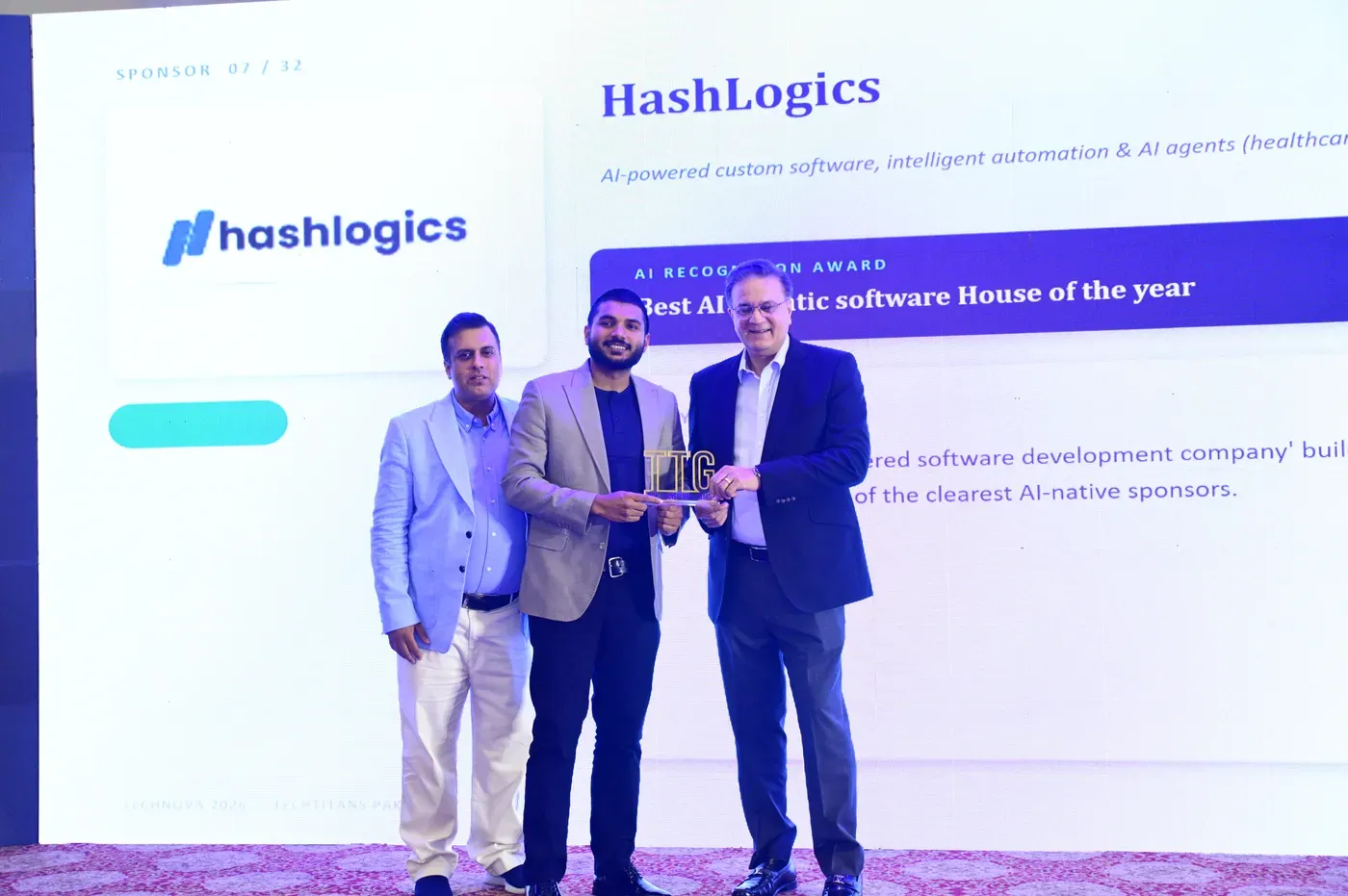
Abdul Basit founded Hashlogics in 2017, and the team runs from Lahore with a US LLC. Clients rate the work 4.8 on Clutch across 22 reviews, and in 2026 it was named Best AI-Native Software House of the Year at TechNova. TankAware, the AI and IoT petroleum site platform we built for Sutherland Excavating Ltd. in Canada, is live and we can show it to you.
Your audit call is with an engineer who has read inspection logs, ATG alarm histories and field tickets like yours. Bring last month's numbers if you have them, and we'll work from those.
- NDA before the first conversation.
- No pitch on the call. A note you could hand to another firm.
- Fixed price per milestone from the Blueprint, so the number isn't a guess.
Go deeper
- Oil and gas →The hub: all eight areas, and which page owns each one.
- Site monitoring for fuel and oilfield →Tank levels, alarm triage and the 30-day inspection record.
- Field operations for oilfield services →Field tickets, approvals, dispatch and ticket-to-cash.
- Fuel distribution software →Run-outs, routes, BOLs and wetstock variance for distributors and bulk plants.
- OpenInvoice, Quorum and Enverus APIs: what a real integration involves →Access models, formats, and what to settle before anyone quotes.
- TankAware case study →The petroleum site platform, in detail.
- Energy software development →Monitoring for energy assets and solar fleets that aren't tanks.
