

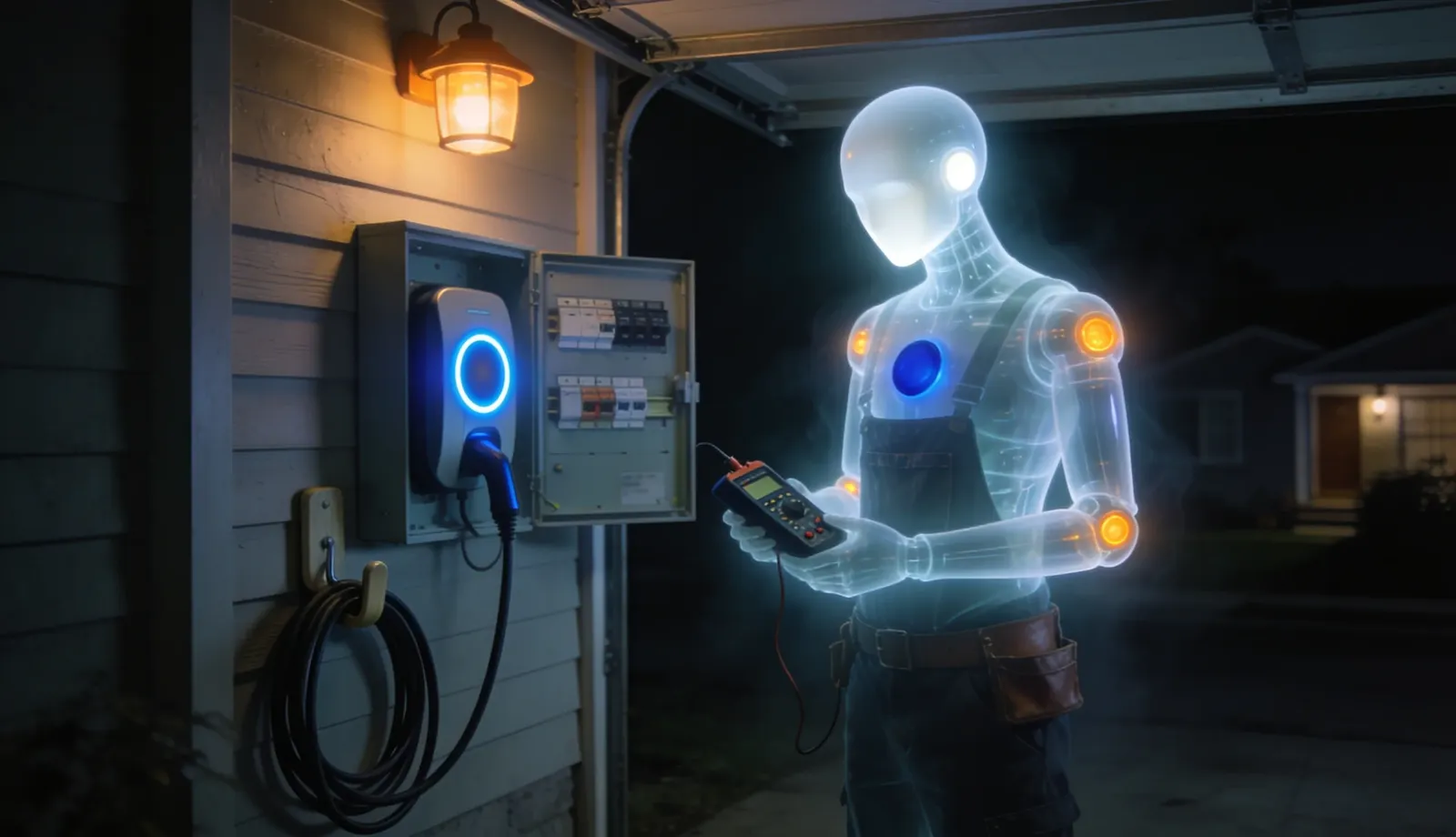
AI, automation and custom software for EV charger and panel-upgrade installers
Every EV charger call hides a panel question, and most shops answer it on the driveway. We build the layer around Jobber, ServiceTitan, Housecall Pro or whatever you run: leads qualified for panel capacity at intake, charger-only and charger-plus-panel quoted separately, permits and utility steps tracked, and estimates followed up until sold.
- 4.8 on Clutch across 22 reviews
- PremiumAudit.io: audit cycle cut 75%, calculation errors cut 95%
- In production for SmartREI, Tankaware, ZyloBase, KiwiWrite
What changes for you
3 things that decide this
- 01Your intake asks the panel questions before anyone books: service amperage, panel age, what's already on it, and a photo of the panel label. Likely-upgrade jobs get flagged and quoted as upgrades from the first call.
- 02Charger-only and charger-plus-panel become two job types with two quote templates, so the load math decides the path early.
- 03The rest of the job runs itself: the permit and utility notification tracked on an install-ready checklist, financing links sent twice, the cold estimate chased, and the solar-plus-EV combo captured as one intake instead of two calls.
On the record
Facts you can check before you call
4.8
Clutch rating from client reviews
4
countries our client work runs in: US, UK, Switzerland, Australia
2017
building since. TechNova 2026: Best AI-Native Software House of the Year
2 mo
of support and maintenance free after launch. NDA before the first call
Six places an EV charger job goes sideways, and what we put in each one
Each one keeps the platform you already run and plugs the gap around it.
The panel question, answered at intake
A web form or your phone line captures service amperage, panel age, major loads and a photo of the panel label before a visit gets booked. Your electrician still runs the load calculation; the software makes sure the inputs arrive first, so the wasted truck roll to a full panel never happens.
AI voice agents for plumbers and electricians →
Two paths, two quotes
Charger-only and charger-plus-panel are different jobs with different margins, so each gets its own quote template, its own parts list and its own scheduling assumptions. A flagged likely-upgrade lead lands in the second path automatically instead of being re-quoted after the site visit.
Estimating automation →
NEC 2026 arithmetic in the qualifying logic
The 2026 code counts a charger at full nameplate, and a load-management setpoint can change the answer. Your qualifying rules encode both, so intake sorts leads the way your estimator would. Where your jurisdiction still runs the 2023 edition, the rules flip with one setting.
What is the NEC 2026 load calculation? →
Permits and the utility, tracked not chased
A charger install can wait on a permit, a utility notification and sometimes a service upgrade. Each job type carries an install-ready checklist that stalls until every item clears, and the right person gets nudged the day one sticks. Filing stays in your name; nothing goes missing.
Dispatch and field automation →
The estimate that would have gone cold
Panel upgrades carry real money and long decision cycles, and they die quietly over a weekend. Follow-up fires on estimate status, the financing link goes out twice, and your estimator opens a callback list each morning instead of a blank screen.
Estimating automation →
Solar-plus-EV, captured as one job
Buyers increasingly ask for the charger and the solar conversation together. One intake flow captures both, splits the scopes, and books the right crew for each, so the combo lead stops being two phone calls and a lost thread.
Electrical business software and reporting →
- Lead arrivesCall, form or referral, any hour.
- Panel questions askedAmperage, age, major loads, label photo.
- Upgrade likelihood flaggedYour qualifying rules, encoded and editable.
- Path chosenCharger-only or charger-plus-panel.
- Quote out, follow-up onTemplate per path; financing link included.
- Install-ready checklistPermit, utility, materials, crew booked.
Your licensed electrician still owns the load calculation. The pipeline just delivers the inputs before the truck.
Panel answers get decided at intake or on the driveway. Only one of those is free.
Every charger lead sounds like the same job on the phone, and half of them aren't. An older home on a smaller service may need a panel or service upgrade before a charger can go in, and under the 2026 code the charger counts at its full nameplate rating in the load calculation. You find that out at intake, or you find it out after a drive.
The fix is unglamorous: ask the panel questions first, every time, with a photo. A homeowner can read an amperage off a panel label in under a minute when the form shows them where to look. Your qualifying rules then sort the lead, and the ones that need the bigger conversation get it up front, priced as what they are.
It also changes the sale. A likely-upgrade lead quoted honestly at intake hears one story from first call to invoice, instead of a cheap number followed by an awkward revision. Shops lose those revised jobs to whoever quoted the truth first.
- Panel amperage, age and major loads captured before booking, with a label photo, every time and on every channel.
- Likely-upgrade leads flagged by rules your estimator wrote and can edit.
- Load-management options flagged where a setpoint saves the service.
We don't replace Jobber, ServiceTitan, Housecall Pro or whatever you run. We build what they won't.
Your field platform is good at jobs, schedules and invoices. What it doesn't ship is an EV-specific intake, a two-path quoting rule, or a checklist that watches a utility notification. Those gaps are what we build, writing back into your board so dispatch never looks at two screens.
Access decides the integration, so we confirm it before anyone estimates a build. Housecall Pro and Jobber expose booking and jobs through public APIs. ServiceTitan needs developer-program access with your tenant credentials. On a spreadsheet, an older FSM or a system you had built years ago, we write into that instead.
- 01Booking, job and customer write-back to your board, with the intake answers attached.
- 02QuickBooks stays your ledger. We read from it for job costing, never re-keying into it, and never touching your books.
- 03Permit portals and financing providers connected where an API exists.
“They will treat your vision like their own and build it that way.”
Ron Klabunde · Founder, SmartREI ↗
Some of the systems we have shipped
- AuditFree. We read your last 20 EV charger leads and count the site visits that quoted a different job than the call did.
- DiagnoseWe map your intake, your quoting paths and your board, with your estimator in the room.
- BuildFixed price from the diagnostic. Tested on your real leads and your own price book.
- RunMonitoring, a named engineer, and the first two months of maintenance free.
Best fit: an electrical shop with real EV charger volume and a platform you've outgrown in places. A one-van owner-operator is better served by an off-the-shelf app, and we'll say so. You can stop after any stage; the audit findings are yours either way.
Before you book
01Can intake really predict which jobs need a panel upgrade?+
It predicts well enough to route, because the inputs are checkable facts: service amperage, panel age, major loads, a label photo. Your estimator writes the flagging rules and edits them as results come in. Nothing replaces the licensed load calculation; the flag just decides which conversation the lead gets first.
02What did NEC 2026 change for charger installs?+
The 2026 code counts an EV charger at 100 percent of its nameplate rating in the load calculation, and it recognizes power control systems, where a managed setpoint stands in for the full draw. Both rules live in your qualifying logic here. Adoption varies by state, so the rules run against whichever edition your jurisdiction enforces.
03Does this handle the utility side of a service upgrade?+
It tracks it rather than replaces it. A service upgrade needs the utility notified and sometimes scheduled, and that step sits on the install-ready checklist with a nudge when it stalls. Your office still makes the call; the job just can't quietly wait three weeks with nobody noticing.
04We also sell solar. Does the intake cover combo jobs?+
Yes, as one flow. The intake captures the charger and the solar interest together, splits the scopes, and books the right crew for each. One conversation for the homeowner, and neither half of the job falls into the other's queue.
05Will it work with our platform?+
Housecall Pro and Jobber expose booking and jobs through public APIs, and ServiceTitan works through its developer program with your tenant credentials. On something else, an older FSM, a spreadsheet, your own build, we write into that. We confirm exact access during the free audit, before any estimate.
06Does the AI ever give electrical advice?+
No. Intake collects facts and photos, flags leads by rules your estimator wrote, and books the visit. It never tells a homeowner their panel is safe, adequate or code-compliant. Load calculations, code judgments and anything touching the panel belong to your licensed electrician, and that line is written into the build.
More for electrical contractors
- AI, automation and custom software for plumbing and electrical contractors →The whole chain, from the first ring to the renewal.
- Electrical contractors →Our page for the wider electrical trade, beyond EV work.
- What is the NEC 2026 load calculation? →The rule behind the panel question, defined plainly.
- Estimating automation →Panel-upgrade estimates followed up and financed.
- AI voice agents for plumbers and electricians →Intake questions asked on the phone, around the clock.
- Best AI answering services for electricians →The packaged tools, ranked, and where a custom build fits.
- AI agents →Our service behind intake systems like this.
