


Underwriting software that shows its work, for investors and syndicators
You need a return number and the reasoning behind it, because a partner is going to ask. Ask a language model for a cap rate and it hands you one that looks right and isn't. So we build it the other way round. Typed inputs. Code that does the maths, every time, the same way.
- 4.8 on Clutch across 22 reviews
- PremiumAudit.io: audit cycle cut 75%, calculation errors cut 95%
- In production for SmartREI, Tankaware, ZyloBase, KiwiWrite
What decides an underwriting build
3 things that decide this
- 01Your maths has to be code, never a model call. ROI, cash flow and cap rate are fixed formulas. Ask a language model to compute one and it hands back something plausible and wrong, which is worse than an error you can see.
- 02Comps are a judgement call wearing a number. Two analysts pick different comparable sales and get two valuations from one address. So your platform has to name the comps it used, and let somebody swap one out.
- 03Extraction is where AI genuinely earns its place. A model reads your lease or rent roll and pulls rent, term and escalation into typed fields, with the clause linked. Anything under your confidence line goes to a person instead of into the model.
Eight places an investment shop leaks time, in your words
These are the eight areas our audits keep finding, written for someone underwriting deals rather than managing doors. Each links to the page that owns it.
The seller who calls while you're underwriting something else
Off-market calls, a broker with an OM, an owner replying to a mailer. We build the intake layer that answers, captures the address and the numbers, checks it against your buy box, and books the conversation with whoever is qualified to have it.
AI phone agents for property →
Tenant calls on the assets you already hold
Own doors and you inherit the maintenance line, whether or not you wanted it. We build the triage layer that answers, escalates a flood or a gas smell to a person immediately, and raises the work order with photos on the right unit.
AI phone agents for property →
Rent rolls keyed by hand, one lease at a time
Somebody types two hundred leases into a spreadsheet and a missed amendment quietly invalidates the model. We build extraction that pulls rent, term, options and escalations into typed fields, links each one to its clause and page, and routes the weak ones to a reviewer.
Property management automation →
Option and notice dates that pass quietly
An option window, a notice period or an escalation date sitting in clause text has no clock attached to it. We turn those into scheduled obligations with an owner and an escalation path, so a date that costs you money is a task rather than a memory.
Property management automation →
Investor reporting that eats two weeks a quarter
Ownership nests: fund, then entity, then property, then unit, and each investor sees one slice of it. We build the ledger and permission model underneath before we build any dashboard, because this is a data problem long before it's a design one.
How to automate owner reports →
Two analysts, one asset, two valuations
Assumptions live in a spreadsheet on somebody's laptop rather than in a system. We give you structured inputs, one engine that prices every deal the same way, and scenario comparison so you can hold two or three versions of a deal side by side before committing.
Custom software for property →
An AVM number with nothing behind it
An automated valuation model gives you one figure and no range. A property worth 380 to 420 shown as a single number looks more certain than the data supports, and somebody acts on that false confidence. We show the range and the inputs that produced it.
Custom software for property →
Portfolio numbers pulled by hand on a Friday
NOI, occupancy, expense ratio, budget variance and debt service live in the accounting system, the property manager's portal and a workbook. We build one read-only view across all of them, by fund, entity, property and unit.
Custom software for property →
Three moments where a number earns trust or loses it, and what each writes back
Here are three stations from the property chain, the ones an investment shop feels hardest. Pick the platform on your operating side to see the write-back; where you hold assets under management, that's where the numbers come from.
Station 01 · The deal that arrives as a PDF
- Today
- An offering memorandum lands as a PDF, and a rent roll arrives as somebody's export with its own row labels. Your analyst keys it in over two days. By then a faster bidder has the property under contract.
- What we automate
- Extraction pulls rent, term, options, escalations and expense lines into typed fields. Each one links back to the clause and page it came from. Anything below your confidence line routes to a reviewer rather than into the model, and each field carries a score so your reviewer checks the weak ones first.
- What stays human
- Your analyst approves the extraction before it becomes an input. A model reads documents here. It never decides what a number means.
Writes to AppFolioRead-only where you also run doors; extracted fields land in your underwriting record.
Station 02 · The number you have to defend
- Today
- ROI lives in a spreadsheet on one laptop, and it breaks the day somebody adds an expense line. Two analysts pick two comp sets and reach two valuations for one address. Then your committee spends the meeting arguing about inputs rather than the deal.
- What we automate
- Typed inputs go into one engine that prices every property the same way, in code. Valuation comes back as a range, with the comps behind it named and swappable. You can hold two or three versions of a deal side by side, and change one assumption to see the return move.
- What stays human
- You choose the comps and you make the call. Picking comparable sales is judgement. A platform that hides that choice inside one number is asking to be trusted blind.
Writes to AppFolioRead-only on operating data feeding the model.
Station 03 · The quarterly report to your investors
- Today
- Distribution statements and quarterly reporting take two weeks to assemble. Ownership nests across funds, entities, properties and units, and each investor sees a different slice of it.
- What we automate
- An append-only ledger with reversing entries. Statements stored as snapshots, so last quarter reproduces exactly when somebody asks. And a portal where each investor sees their own slice and nobody else's. Reports go out on a schedule with the numbers already in them.
- What stays human
- You write the paragraph explaining the quarter, and you approve every distribution. We read your financial data; the money moves through your systems and your people.
Writes to AppFolioRead-only: rent roll, ledger and work orders feed the report.
Our property hub walks the whole chain. Every station keeps the maths in code and the judgement with a person.
A spreadsheet and a packaged underwriting tool both work, or whatever you run does. Here's the line between using one and building on it.
Most investors already own a spreadsheet that computes ROI correctly. The formula isn't the problem. It lives on one laptop, it breaks when somebody adds an expense line, and nobody else has a reason to trust the number. For a shop doing a handful of deals a year, that's still the right tool, and we say so on audit calls.
You outgrow it at three points. First, when deal flow passes what one analyst can underwrite by hand. The constraint stops being the maths and becomes the keying. Second, when a number has to be defended to a lender, a committee or a limited partner. Now the comps and the assumptions have to be visible rather than buried. Third, when you report to investors. Ownership nests across funds, entities, properties and units, and each one sees a different slice. That last one is a ledger and permissions build, not a dashboard.
Where you also hold assets under management, we build around the operating stack rather than replacing it. Your property manager stays on AppFolio, Buildium, Yardi, Rent Manager or whatever they run, and we read from it at the depth that account exposes. MLS and IDX data needs its own permission cleared first. RESO reports that more than 90% of MLSs run certified Web API services, and that certification standardises the shape of the data, never your right to use it.
- 01Deterministic code does every calculation. A model reads documents and drafts text, and that's the whole of its job.
- 02Every extracted field links to its clause, and low confidence goes to a person rather than into the model.
- 03Read-only against your operating and accounting systems. Nothing we build moves money or writes a ledger entry.
Fair housing, consent and your trust account are design decisions we make first, on paper, with you
Property is the sector where an algorithm can get you sued: screening models, rent-setting tools and automated texting all sit under fair-housing, consumer-protection and consent rules that are tightening, and the tenant or the regulator won't care that the vendor said it was fine. So every build starts with a one-page map of what the software decides, what it only proposes, and where a person signs off.
What follows is simple to state, and we put it in writing. Screening and pricing decisions stay with a person and a documented policy; the software gathers and presents. Consent is captured before anyone is texted. Wire instructions are never relayed by software. Trust accounting stays in your PMS; we read balances, we don't move money. And every automated touch is logged so you can show what happened and why.
- 01Screening, pricing and notice decisions stay human, with the policy written down.
- 02Consent captured before automated texting; opt-out honoured everywhere.
- 03Every extracted number traceable to its clause, so a committee, a lender or a limited partner can check any figure you show them.
“They will treat your vision like their own and build it that way.”
Ron Klabunde · Founder, SmartREI ↗
“They really help you understand the problem and deliver solutions in a short time frame.”
Johannes Peter · CEO, TomoDomo Coliving
Some of the systems we have shipped
- AuditFree. We read how a deal moves from PDF to decision today, where the assumptions live, and how long your quarterly investor reporting takes to assemble.
- DiagnoseWe map the path into your PMS or CRM and sit with your leasing, maintenance and accounting desks for an afternoon.
- BuildFixed price per milestone from the Blueprint. Tested on your real units, real work orders and real leads, under NDA.
- RunMonitoring, a named engineer, and the first two months of maintenance free.
Best fit: a hundred doors or more, or a brokerage with a team and a transaction desk, and a platform you've outgrown in places. Not a fit yet: a landlord with a dozen units who needs the phone picked up, and we'll say so. You can stop after any stage; the audit note is yours either way.
Before you book
01Can AI calculate a property's ROI or cap rate directly?+
No, and it shouldn't be asked to. A language model predicts plausible text rather than doing arithmetic. So a return it computes can look correct and still be wrong, which is the worst kind of error because nobody catches it. Code runs your ROI, cash flow and cap rate formulas from typed inputs. AI's job is reading documents and drafting text, and it stops there.
02What is an AVM, and can you trust the number it gives you?+
An automated valuation model estimates a property's worth from data alone, with nobody walking the asset. It can't see condition, a recent renovation, or anything outside the data it learned from. Trust the range it implies, not the single figure most tools show you. A point estimate with no band around it is a guess with a decimal point attached.
03How does AI help with rent rolls and lease review?+
It extracts terms, never conclusions. A model reads your lease or rent roll and pulls rent, term length, options and escalation dates into fields a person can check in seconds. Every number links back to the clause it came from. Anything below your confidence line goes to a reviewer instead of straight into the return. Ask any vendor what happens to the fields their model was unsure about. That answer tells you whether a person is genuinely in the loop.
04How do comps get chosen, and does that change the valuation?+
Yes, and by a lot. Choosing comparable sales is judgement. Distance, condition, concessions and timing all move the answer, and two analysts can reach two valuations for one address. Your platform should show which comps it used and let an analyst swap one out, rather than hiding that choice inside a single number. Similarity search is good at surfacing candidates and bad at making the final pick, so we build it as a ranking aid and leave the decision with you.
05Can you build investor reporting for a fund or a syndication?+
Yes, and the hard part isn't the dashboard. Ownership nests across fund, entity, property and unit, and each investor may see one slice and nothing else. So we build the ledger and the permission model first. Entries are append-only with reversals rather than overwrites, and statements are stored as snapshots, so last quarter reproduces exactly when somebody asks. The report is the easy layer on top of that.
06Do you work with the property manager who runs our assets?+
Yes, and we read from their system rather than replacing it. Your manager keeps AppFolio, Buildium, Yardi, Rent Manager or whatever they run, and we pull rent roll, ledger and work-order data at the depth that account exposes. We confirm access during the audit instead of promising it on a call. Everything on our side is read-only, so nothing we build can change an operating ledger or a trust account.
07How do you price an investment analysis build?+
Scoping calls cost nothing. Every build starts with a fixed-fee Blueprint: an engineer reads your real systems and writes the plan, with a fixed price for each milestone rather than a guess. The fee is credited in full against the build, and if the plan isn't one you'd act on, you don't pay for it. What drives the number is how many data sources feed your engine, from manual entry through to MLS and lease extraction, plus whether investor reporting is in scope. We won't quote before seeing those, because a figure given then is a guess wearing a decimal point.
08What does the free audit look at?+
Four things. How a deal moves from PDF to decision today, and how many hours that takes. Where your assumptions live, and who can change them. How long quarterly investor reporting takes, and what it gets built from. And what your operating and accounting systems already expose. You leave with a one-page map and a build order, yours to keep either way.
A senior engineer, not a sales rep
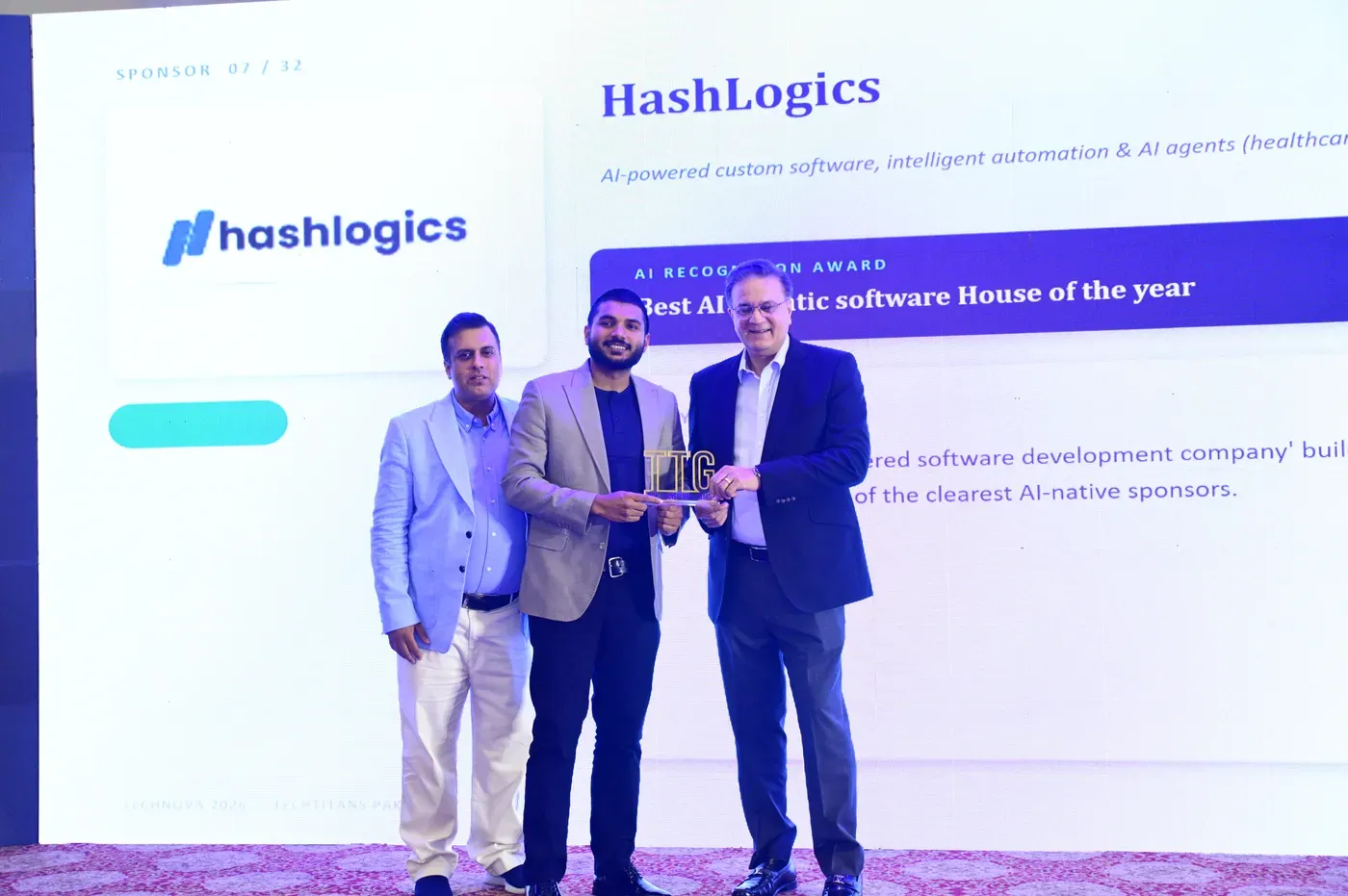
Abdul Basit founded Hashlogics in 2017, and the team runs from Lahore with a US LLC. Clients rate the work 4.8 on Clutch across 22 reviews, and in 2026 it was named Best AI-Native Software House of the Year at TechNova. SmartREI, an investment-analysis platform, and TomoDomo, a coliving management platform in Switzerland, are two of the property systems we built and can show you.
Your audit call is with an engineer who has read lead logs, work-order queues and owner reports like yours. Bring last month's numbers if you have them, and we'll work from those.
- NDA before the first conversation.
- No pitch on the call. A note you could hand to another firm.
- Fixed price per milestone from the Blueprint, so the number isn't a guess.
Go deeper
- AI, automation and custom software for property →The whole chain, for investors, managers and brokerages.
- Custom software for property →Portals, dashboards and the operating layer your tools won't build.
- AI and automation for brokerages →Lead to close, the transaction desk and the broker's numbers.
- Property management automation →Work orders, delinquency, renewals and the owner report.
- SmartREI →The ROI engine, investor and realtor dashboards, and the CRM sync behind them.
- How to automate owner reports →Statements generated on a schedule from the data you already hold.
- Multi-tenant AI needs isolation you can prove →Why one investor's slice must never surface in another's portal.
