

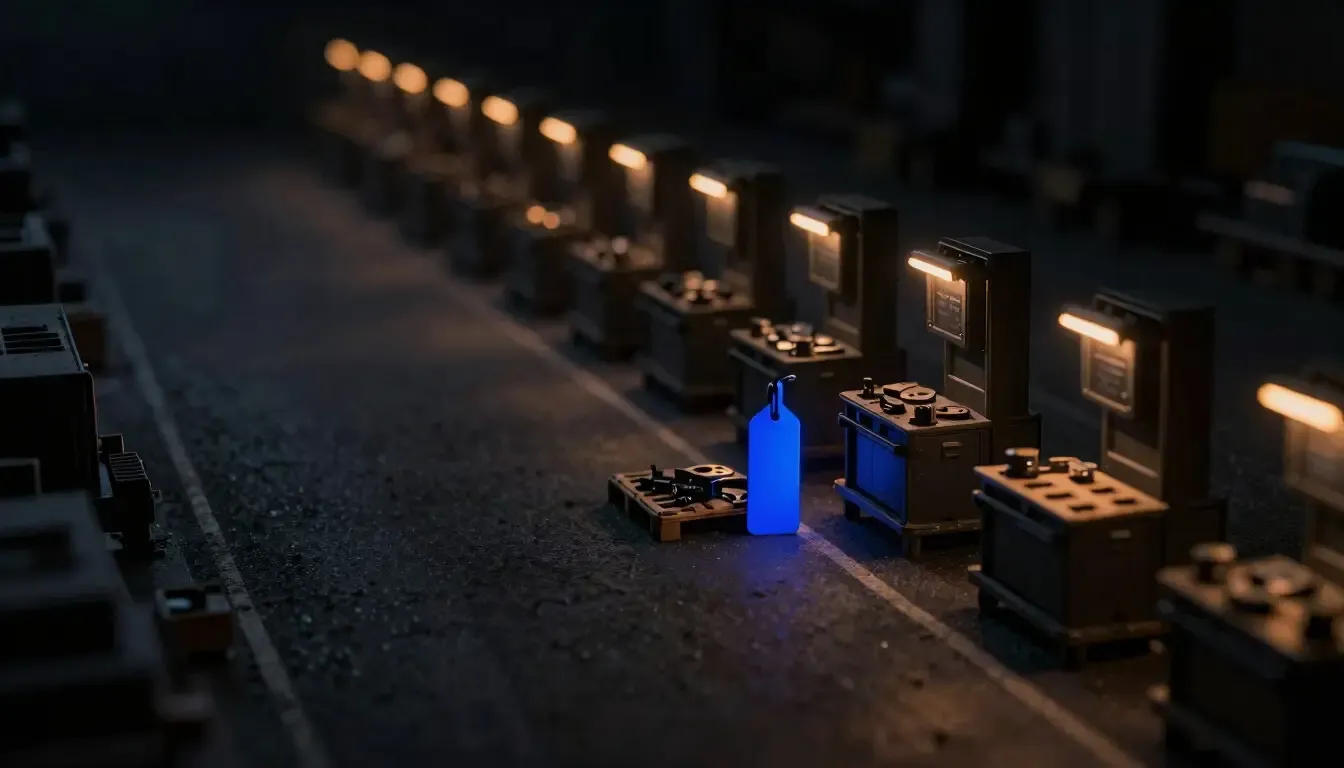
Where is job 4471? The question a plant answers by walking
You ask your ERP where a job stands, and it gives you where the job stood this morning. To find out where it actually is right now, someone still has to walk the aisle and look.
The short version
4 things that decide this
- 01Half of manufacturers still run the floor on spreadsheets or paper next to their main system, according to Weever Software. That gap is exactly why a live job's location is often a mystery until someone physically checks.
- 02The ERP knows what was planned. The floor knows what actually happened, and those two records rarely update each other in real time, which is why they drift apart by the time anyone asks a question.
- 03Plant telemetry closes that gap when the alerts are designed to be trusted: few, specific and escalated to a person, not a screen that pages everyone every time a sensor blips.
- 04A shop doesn't need to replace its ERP to fix this. It needs the floor to report itself, automatically, into the system that's supposed to already know.
You already know this walk
A customer calls. They want to know where their order stands. You pull up the job in your ERP, and it tells you the job was released to the floor eleven days ago. That's true, and it's also useless, because it doesn't tell you whether the job is still waiting at the first machine or shipping out the dock door right now.
So someone walks. Down the aisle, past three work centers, scanning traveler sheets clipped to bins, until they find job 4471 sitting exactly where nobody expected it. That walk isn't a failure of the person doing it. It's the system working as designed, because the design never included the floor reporting back.
Paper and spreadsheets aren't a failure, they're a default
Half of manufacturers still run the floor on spreadsheets or paper next to their main system, per Weever Software's research into shop-floor practices. That's not a fringe number. It's the middle of the industry, and it explains why "where is job 4471" is such a common question rather than a rare one.
The paper isn't there because anyone likes it. A traveler sheet is cheap, it doesn't need a login, and it survives a dropped connection or a machine that's been running since before anyone in the building was hired. The trouble starts when that traveler is the only record. It updates at the machine, in ink, and it doesn't update the ERP until someone re-types it, usually at the end of a shift, sometimes later.
By the time that re-typing happens, the ERP's picture of the job is already stale. Ask it a question in the meantime, and you get yesterday's answer to today's question.
- Job releasedERP creates the record, plan and schedule attached
- Floor starts workTraveler moves, machine runs, nothing reports back yet
- Someone asksThe ERP answers with the plan, not the reality
- Someone walksThe only way to get the real answer, today
- End of shiftTraveler gets re-typed, ERP catches up, hours later
Plant telemetry closes the gap between the second row and the third, so the walk stops being necessary.
The floor reports itself, and the alerts earn your trust
The fix isn't a bigger ERP. It's getting the floor to report what it already knows, automatically, back into the system people are already checking. That's plant telemetry: sensors, scans and machine signals that update a job's real status as it happens, instead of waiting for a shift to end.
We've shipped work like this: plant telemetry with alerts the team actually trusts, not the kind that page someone every ten minutes over nothing. That distinction matters more than the sensors themselves. An alert system that cries constantly trains people to ignore it, and an ignored alert is worse than no alert, because it creates false confidence that someone would notice if something went wrong.
Getting the alerts right means being specific and sparing. A machine going quiet mid-run gets flagged. A job sitting fifteen minutes longer than its neighbors on a normal day doesn't. The team decides what actually deserves a ping, and the system respects that boundary instead of flooding every channel by default.
- 01Job status updates as work happens, not at the end of a shift.
- 02Alerts stay few and specific, so people keep checking them.
- 03The ERP still owns the plan. Telemetry owns what's actually true right now.
A person still decides what to do about it
None of this hands the floor over to software. A line still stops on a person's call. A job still gets held, rushed or rerouted by a human who understands the customer, the deadline and the machine's real condition better than any sensor. What changes is how fast that person gets an accurate picture to decide from.
That's the actual win. Not a floor that runs itself, but a floor that stops making you walk to find out what it already knows.
Some of the systems we have shipped
Related questions
01Do we need to replace our ERP to fix this?+
No. Plant telemetry sits alongside the ERP you already run and feeds it live status instead of replacing its planning and scheduling role. The ERP still owns the plan; the floor just stops lying about what's actually happening.
02What if our machines are old and don't have built-in sensors?+
Retrofitting older equipment with sensors and scan points is common, and it's usually cheaper than it sounds because you're only instrumenting the handful of work centers where visibility actually matters, not the whole plant at once.
03How do you stop alerts from turning into noise?+
By starting narrow. A handful of specific, high-value alerts that the team actually acts on beats a system that flags everything and gets muted within a week. The team defines what's worth a ping before anything gets built.
04How long does a project like this take?+
Scope follows how many work centers and systems are involved, so we don't quote a timeline before seeing your floor. A pilot on a few work centers is a different project from plant-wide telemetry.
