


Shop-floor automation: the quote that reaches the schedule, the job you can find without walking, and the margin before it ships
Most of your plant's lost hours sit between the quote and the invoice. We build that middle, around Epicor, NetSuite, SAP Business One, JobBOSS, Fishbowl or whatever you run.
- 4.8 on Clutch across 22 reviews
- PremiumAudit.io: audit cycle cut 75%, calculation errors cut 95%
- In production for SmartREI, Tankaware, ZyloBase, KiwiWrite
What you get
3 things that decide this
- 01Quoting that works from your own rates, routings and job history instead of the estimator's memory, with the accepted quote landing in your ERP as a work order and a slot on the schedule rather than a note to the planner.
- 02Floor status you can read without walking it: operation completions captured at the machine, plant telemetry behind it, and alerts baselined per line so your team keeps trusting them. We've shipped that telemetry and alerting in production.
- 03The traveler captured where the work happens, so nobody re-types it at 6pm, and live job costing and OEE across your ERP, machine data and accounting, so you see the margin while the job is still in the building.
Where a job leaks hours between the quote and the invoice
Three stations from the hub's chain, the ones a manufacturer feels most. Pick the system you'd want written to; SAP Business One, JobBOSS, Fishbowl, Katana and the rest follow the same pattern, to the depth your account exposes.
Station 01 · Quote to schedule, load to carrier
- Today
- Your estimator prices from memory and one spreadsheet, then walks it to the planner. On the logistics side your dispatcher works a board and a phone to find the carrier who'll take the lane at the rate.
- What we automate
- Quoting from your own rates, routings and job history, with the accepted quote becoming a work order and a schedule slot; on the load side, carrier shortlisting from your history and lane, tender out, and confirmation captured against the load.
- What stays human
- Your estimator signs the price, and your dispatcher tenders the load. Software assembles and proposes, and never commits either one.
Writes to NetSuiteQuote, then sales order and work order on acceptance.
Station 02 · Where is job 4471, where is the load
- Today
- Somebody walks the floor to answer the first question and picks up the phone to answer the second, and the traveler gets re-typed into a spreadsheet at the end of the shift.
- What we automate
- Operation status captured at the machine with plant telemetry behind it and alerts tuned per line, plus shipment status pulled from what your carriers and ELDs publish, with exceptions queued rather than a wall of green dots.
- What stays human
- Your supervisor still calls the line stop, and your dispatcher still decides what an exception is worth doing about.
Writes to NetSuiteOperation completions and job status posted back.
Station 03 · The margin before it ships
- Today
- You find out what a job or a load really cost weeks later, when the reconciliation lands. OEE is a spreadsheet somebody updates on Fridays, and cost per mile comes off telematics nobody opens.
- What we automate
- Live job and load costing pulled from your ERP, MES, telematics and accounting, OEE derived from the same telemetry that raises the alerts, and cost per mile and per load kept current, read-only where that's all your access allows.
- What stays human
- You decide what a bad margin means. We build the number and show its working; the pricing call is yours.
Writes to NetSuiteReads costs and postings; writes nothing back.
The line stop, the price and the release stay with a person at all three. Software assembles and proposes.
Four things we build on a shop floor, and what each one plugs into
Quoting built from your rates and your job history
Your estimator prices from memory, one spreadsheet and a feel for what the last similar part took, and when he's on holiday the quotes stop. We build quoting off your own rate table, routings and closed-job history, so the number has working you can show a customer, and the accepted quote becomes a work order and a schedule slot in your ERP.
Business process automation →
Plant telemetry with alerts your team still trusts
An alarm that cries every hour trains your operators to clear it without reading it, which is exactly how the one that mattered gets missed. We've shipped telemetry and predictive alerting in production, baselined per line rather than against a fleet average, with a drifting sensor treated as its own event class and every alert tracked for whether anyone acted on it.
AI agents and automation →
Travelers captured at the machine, not re-typed at 6pm
Half a plant still runs the floor on paper travelers and a spreadsheet next to the main system, and the day's work gets keyed in twice by somebody who'd rather go home. We put the traveler on a tablet at the machine: operation completions, quantities, scrap and notes captured where they happen, offline when the network drops, and posted back to your ERP.
How do you replace paper travelers? →
Live job costing and OEE, read-only where that's all you have
You learn a job's real margin when the QuickBooks reconciliation lands weeks later, and by then the quote that lost money has been repeated four times. We build dashboards across your ERP, machine data and accounting: cost against quote per job while it's still running, OEE off the same telemetry, and availability, performance and quality kept apart so a bad number tells you which one it was.
Custom software development →
Where the packaged tools stop: what an MES really does, and when you should just buy one
An MES, a manufacturing execution system, sits between your ERP and the machines. It takes the work order your ERP released, dispatches it to a work centre, collects what actually happened (operation start and finish, quantities, scrap, downtime reasons, machine signals), enforces the routing so a step can't be skipped, and hands production and cost data back up. That's a real category doing real work, and if you run repetitive high-volume production across several lines with genuine quality gates, you should buy one and we'll help you choose.
Below that, the maths changes. A 40-person job shop running one-off and small-batch work usually finds the MES priced for a plant ten times its size, configured over months, and demanding a discipline the floor won't sustain. Metal fab plus a monolithic ERP is where twelve-month implementations go to die, as the shop forums and vendors themselves put it (eziil.com), and a buyer who has already lived through one ERP rollout tends to know it. What such a shop actually needs is usually three things: the traveler off paper, status visible without the walk, and job cost against quote while the job is running.
So we'd rather scope those three around the ERP you already own than sell you a second system to run alongside it. If your audit says you genuinely need an MES, that's what the audit note will say, and we don't sell one. And when we build, we build the layer, not a replacement: the line does not stop because your software is thinking.
- 01An MES is worth buying for repetitive, multi-line production with hard quality gates and the staff to run it.
- 02Below that, the traveler, floor status and live job cost usually pay for themselves first.
- 03Your ERP stays the system of record, and our layer never becomes a second version of the truth.
No software runs a line, releases a lot or dispatches a truck without a person. We write that down first.
A plant, a warehouse and a fleet sit under rules that don't bend for software: a line stops on a person's call, a food lot is released or held by QA, a load is tendered by a dispatcher, and the record (the traveler, the batch record, the POD) has to survive an auditor or a recall. So every build starts with a one-page map of what the software records, what it only proposes, and where a person signs.
What follows is simple to state, and we put it in writing. Alerts are designed to be trusted, which means few, specific and escalated; an alarm that cries every hour trains people to ignore it. Records are timestamped, immutable and gap-honest. Invoices, releases and tenders are approved by the person who owns them. And every automated touch is logged so an auditor, a customer or a regulator can read what happened, and when.
- 01Releases, tenders and invoices approved by a person; the software assembles, routes and chases.
- 02Alerts few and trusted; records immutable and gap-honest.
- 03A work order is released, a job is scrapped and a price is signed by the person who owns it; the software prepares the paperwork.
“They will treat your vision like their own and build it that way.”
Ron Klabunde · Founder, SmartREI ↗
“TankAware has revolutionized how we manage petroleum sites. The real-time data and automation have exceeded expectations.”
Blake Sutherland · President, Sutherland Excavating Ltd.
Some of the systems we have shipped
- AuditA free 45-minute call. We trace one real job from the quote to the invoice, and count every place somebody re-types what a machine already knew.
- DiagnoseWe map the path into your ERP, TMS or WMS and accounting, and walk the floor or sit with dispatch for an afternoon.
- BuildFixed price per milestone from the Blueprint. Tested on your real orders, jobs and loads, under NDA.
- RunMonitoring, a named engineer, and the first two months of maintenance free.
Best fit: an operator with an ERP, TMS or WMS you've outgrown in places, more than one site or shift, and a month-end you can feel. Not a fit yet: a ten-person shop that needs its first system, and we'll say so. You can stop after any stage; the audit note is yours either way.
Before you book
01Do we need an MES, or do we need this?+
You need an MES if you run repetitive production across several lines with real quality gates and people to administer it. You need this if you're a job shop or a fabricator whose floor still runs on paper travelers next to the main system, whose planner answers status questions by walking, and whose job costs arrive weeks late. Our audit tells you which one you are, and if the answer is an MES we'll say so and help you pick.
02Will you replace our ERP?+
No. Your Epicor, NetSuite, SAP Business One, JobBOSS or whatever you run holds the item master, the rates and years of history, and pulling it out to fix a traveler problem is a bad trade. We build the layer around it and post back to it, so your ERP stays the system of record and nobody has to relearn where the truth lives.
03Our line data already sits in a historian. Why add anything?+
Because a historian records and doesn't act. It can't turn a deviation into an assigned job, hold one method across four plants, or stop an uncertified operator being scheduled. That's the layer above it, and it's where the drift you're paying for actually lives.
04How do you keep alerts from becoming noise?+
By baselining each line against its own normal instead of a fleet average, and by treating an unanswered alert as a defect in the system rather than an operator's failure. Readings move for reasons that aren't faults: ambient temperature, a shift change, a batch running hot. We've shipped this in production, and we handle a drifting sensor as its own event class, because a device two percent low for months quietly poisons the baseline everything else is judged against.
05Will a tablet on the floor work when the network drops?+
Yes, if offline is designed in from the start rather than bolted on. The entry is written to the device with its own timestamp and queued, then reconciled on reconnect, and we keep both clocks as separate facts. That way nobody can argue the record was written up later in the office.
06Can you connect to our machines?+
To the depth your equipment and your account expose, and we confirm that in the audit rather than promising it on a call. Some controllers publish an open protocol, some sit behind a vendor gateway with its own licence, and some older machines need a sensor added rather than a connector. We scope what's actually on your floor first, because that's a design input and not an afterthought.
07What is the free Floor-to-Invoice Audit?+
It's a 45-minute call and a workflow review. We trace one real job from the quote through the traveler and the floor to the invoice, count the manual touches, look at what your ERP and machines expose, and hand you a one-page map ranked by hours lost. You keep it whether you hire us or not. Build pricing is fixed per milestone in the Blueprint, and the first two months of maintenance are free.
A senior engineer, not a sales rep
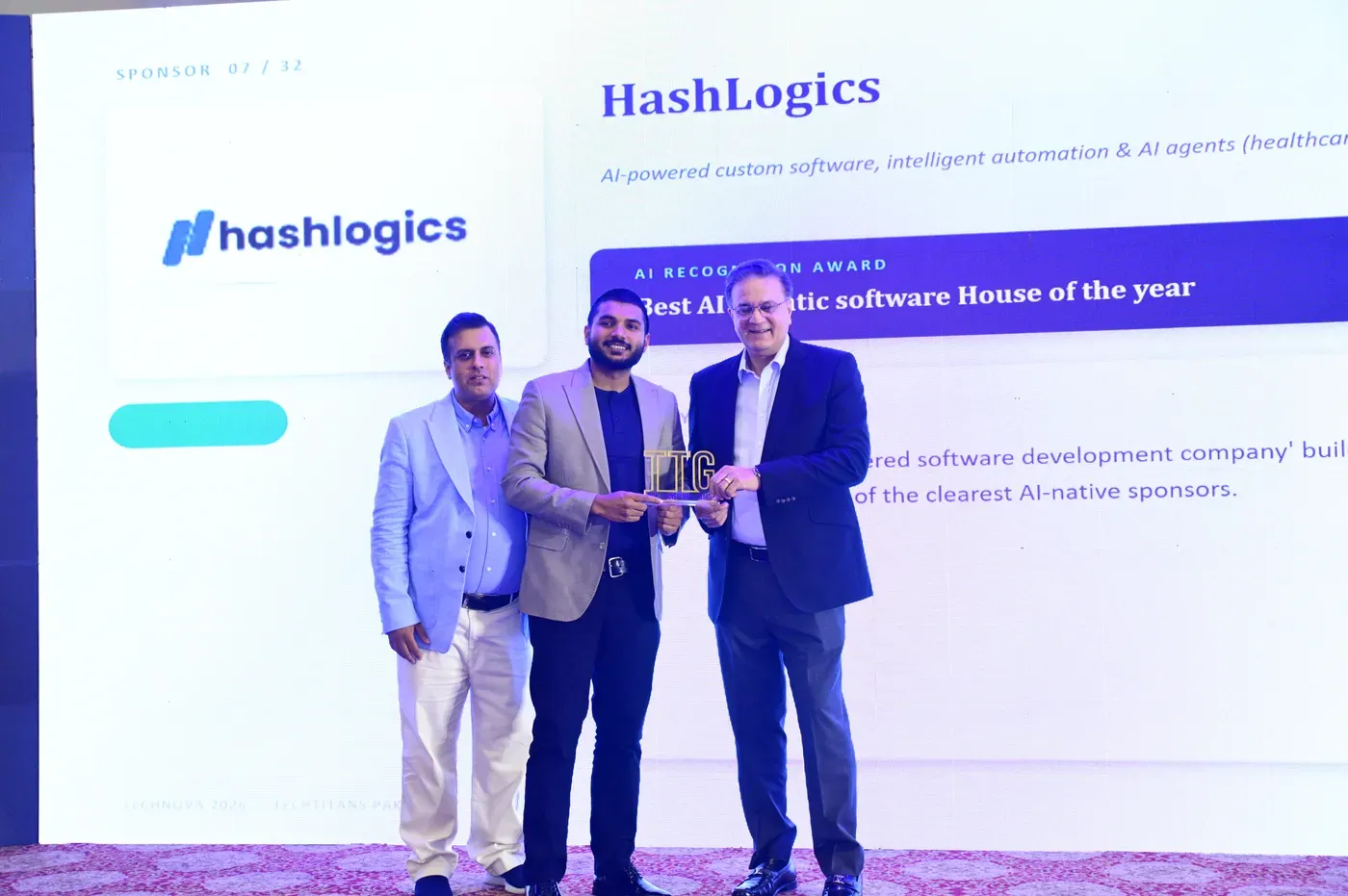
Abdul Basit founded Hashlogics in 2017, and the team runs from Lahore with a US LLC. Clients rate the work 4.8 on Clutch across 22 reviews, and in 2026 it was named Best AI-Native Software House of the Year at TechNova. Shift Link, the workforce-compliance and scheduling platform for regulated staffing, and WAIQ, the operations and execution platform for a multi-site business, are two of the systems we built and can show you.
Your audit call is with an engineer who has read travelers, load boards and month-end reconciliations like yours. Bring last month's numbers if you have them, and we'll work from those.
- NDA before the first conversation.
- No pitch on the call. A note you could hand to another firm.
- Fixed price per milestone from the Blueprint, so the number isn't a guess.
Go deeper
- AI and software for manufacturers and logistics →The hub: all eight areas, and the whole chain.
- Manufacturing software and automation →Written for job shops, fabricators and machinery makers.
- Custom software for manufacturers and logistics →Integration, EDI, portals and the multi-site layer.
- Food and beverage software →Lots, batch records and FSMA 204 for processors.
- Best MES software for small manufacturers →What an MES does, and when a small shop should buy one.
- NetSuite, Epicor and SAP B1 integration: what a real build involves →What each one exposes, and what to do where it stops.
- How do you replace paper travelers? →Capture at the machine, offline, posted back to the ERP.
- Do you need an ERP to run a job shop? →Often not yet. Here's what to fix first.
- Where is job 4471: the question a plant answers by walking →Floor visibility, and why the traveler gets re-typed.
- WAIQ case study →One operating method across every site, department and role.
