


Logistics automation: the order typed once, the check call nobody makes, and every billable touch on the invoice
Your dispatchers and coordinators spend the day on work a machine should be doing. One shipment gets keyed into the TMS, the WMS, a spreadsheet and the accounting system. Check calls and tracking chases all afternoon. We build that layer around McLeod, ShipStation, your WMS, QuickBooks or whatever you run, and your dispatcher still tenders every load.
- 4.8 on Clutch across 22 reviews
- PremiumAudit.io: audit cycle cut 75%, calculation errors cut 95%
- In production for SmartREI, Tankaware, ZyloBase, KiwiWrite
What you get
3 things that decide this
- 01Orders and loads entered once, by nobody. An intake agent reads the email, the PDF or the EDI 204, creates the load in your TMS or WMS, and queues anything it isn't sure about for a coordinator to accept in one click.
- 02Your dispatcher's afternoon back. Check calls, status updates and POD chasing handled by agent against what the carrier or the ELD publishes, with only the exceptions routed to a person who can actually do something about them.
- 03Every touch on an invoice. Billing assembled from the WMS events themselves, rated against each client's contract, the unbilled touch flagged before month end, and the result written back to QuickBooks or whatever you keep the books in.
Where a load leaks hours between the tender and the invoice
Three stations from the hub's chain, the ones a 3PL, a brokerage or a fleet feels most. Pick the system you'd want written to; Manhattan, Blue Yonder, project44, FourKites, Descartes, Samsara and the rest follow the same pattern, to the depth your account exposes.
Station 01 · The order that gets typed four times
- Today
- Your orders and tenders arrive as email, a PDF attachment, a phone call or an EDI 204, and somebody re-keys the same shipment into your TMS, your WMS, a spreadsheet and the accounting system before lunch.
- What we automate
- An intake agent reads the document or the EDI, extracts the fields, creates the order or load in your system of record, and puts anything it isn't sure about into a queue your coordinator accepts or corrects in one click.
- What stays human
- Your coordinator owns the queue, and a low-confidence read never becomes an order on its own.
Writes to NetSuiteSales order created with lines, customer and dates.
Station 02 · Quote to schedule, load to carrier
- Today
- Your estimator prices from memory and one spreadsheet, then walks it to the planner. On the logistics side your dispatcher works a board and a phone to find the carrier who'll take the lane at the rate.
- What we automate
- Quoting from your own rates, routings and job history, with the accepted quote becoming a work order and a schedule slot; on the load side, carrier shortlisting from your history and lane, tender out, and confirmation captured against the load.
- What stays human
- Your estimator signs the price, and your dispatcher tenders the load. Software assembles and proposes, and never commits either one.
Writes to NetSuiteQuote, then sales order and work order on acceptance.
Station 03 · Bill by the touch
- Today
- Storage bills reliably and the handling doesn't. The pick, the pack, the relabel and the pallet you moved twice get reconciled by hand at month end, and some of them are simply never invoiced.
- What we automate
- Billable touches assembled from the WMS events themselves, rated against the client's contract, the unbilled touch flagged before month end, and the invoice drafted and written back to your accounting system.
- What stays human
- Your controller approves the invoice. Every automated line shows the events it came from, so an argument with a client is a five-minute conversation.
Writes to NetSuiteInvoice drafted against the customer record.
The tender, the exception call and the invoice approval stay with a person at all three. Software assembles, routes and chases.
Four things we build around a TMS or a WMS, and what each one plugs into
Intake agents for orders, loads and tenders
Orders reach you as an email body, a PDF attachment, a phone call and an EDI 204, and a coordinator types the same shipment into four places before lunch. We put an agent in front of it: it reads the document, extracts stops, references, commodity and dates, creates the order or load in your TMS or WMS, and sends what it can't read confidently to a queue rather than guessing.
AI agents and automation →
Carrier communications handled by agent
Check calls, status chasing and hunting for a POD eat your dispatcher's afternoon, and every hour of it is work nobody would choose. We build agents that run the check calls and the status chase, pull what the carrier or the ELD already publishes, chase the missing POD, and route only the exceptions to a dispatcher who can act on them.
How do you automate carrier check calls? →
EDI exception queues for 204, 210 and 214
Your EDI works right up until it doesn't, and then the exceptions get handled by email and somebody's memory of what the customer said last time. We build the queue that should exist: tenders that failed to load, invoices your customer rejected, status messages that never went out, each one owned, aged and cleared, with the reason recorded rather than remembered.
Custom software development →
Bill by the touch, straight from the WMS events
Storage bills every month without fail, and the picks, packs, relabels and the pallet you moved twice quietly don't, so your billing spreadsheet gets rebuilt by hand and some revenue simply evaporates. We build billing off the warehouse events themselves, rated per client contract, with the unbilled touch flagged before month end and the invoice written back to QuickBooks or whatever you run.
How to automate 3PL billing by the touch →
Where the packaged tools stop: your TMS does the core, the seams are ours
Your TMS or WMS does the hard central job well, and we're not proposing you replace it. Rating, tariffs, carrier setup, wave planning, the label and the item master took years to get right, and pulling that out to fix a billing problem is a bad trade. So the question worth asking isn't which system is best. It's where your people are still doing work the system was never designed to reach.
Those are the seams, and there are five of them. How the order gets in, when it arrives as an email or a scan. How carriers get chased and how a POD comes back. What happens to an EDI message that fails. How a month of warehouse touches becomes an invoice somebody can defend. And what a client can see without phoning you. Those are the places your coordinators lose their afternoons, and none of them is a flaw in your TMS.
Two of them deserve saying plainly, because operators tell us the same thing every time. The load moved and proof of it did not, because the POD was photographed at a gate with no signal and uploaded two hours later with the wrong timestamp. And telematics tells you location, not what it cost, so cost per mile stays an estimate somebody rebuilds in a spreadsheet each quarter. We build both of those properly, keeping the device clock and the server clock as separate facts, because a record that can't be challenged is worth more than a fast one.
- 01Your TMS or WMS stays the system of record. Our layer reads and writes to it, and never competes with it.
- 02Offline-first capture with both clocks kept, so a POD taken in a dead zone still holds up in a dispute.
- 03Where an API stops, a reviewed queue starts, and the record says which person accepted it.
No software runs a line, releases a lot or dispatches a truck without a person. We write that down first.
A plant, a warehouse and a fleet sit under rules that don't bend for software: a line stops on a person's call, a food lot is released or held by QA, a load is tendered by a dispatcher, and the record (the traveler, the batch record, the POD) has to survive an auditor or a recall. So every build starts with a one-page map of what the software records, what it only proposes, and where a person signs.
What follows is simple to state, and we put it in writing. Alerts are designed to be trusted, which means few, specific and escalated; an alarm that cries every hour trains people to ignore it. Records are timestamped, immutable and gap-honest. Invoices, releases and tenders are approved by the person who owns them. And every automated touch is logged so an auditor, a customer or a regulator can read what happened, and when.
- 01Releases, tenders and invoices approved by a person; the software assembles, routes and chases.
- 02Alerts few and trusted; records immutable and gap-honest.
- 03Tenders, exception calls and invoices are approved by the person who owns them; the agent assembles, chases and queues.
“They will treat your vision like their own and build it that way.”
Ron Klabunde · Founder, SmartREI ↗
“TankAware has revolutionized how we manage petroleum sites. The real-time data and automation have exceeded expectations.”
Blake Sutherland · President, Sutherland Excavating Ltd.
Some of the systems we have shipped
- AuditA free 45-minute call. We trace one real load from the tender to the invoice, and count every manual touch on the way.
- DiagnoseWe map the path into your ERP, TMS or WMS and accounting, and walk the floor or sit with dispatch for an afternoon.
- BuildFixed price per milestone from the Blueprint. Tested on your real orders, jobs and loads, under NDA.
- RunMonitoring, a named engineer, and the first two months of maintenance free.
Best fit: an operator with an ERP, TMS or WMS you've outgrown in places, more than one site or shift, and a month-end you can feel. Not a fit yet: a ten-person shop that needs its first system, and we'll say so. You can stop after any stage; the audit note is yours either way.
Before you book
01Would you replace our TMS or WMS?+
No, and we build around it deliberately. Your system carries years of rates, tariffs, carrier setup and integrations, and tearing that out to fix a proof-of-delivery or a billing problem is a bad trade. We connect to it, write back to it, and build the layer it was never designed to cover.
02Can an agent really make our check calls?+
Yes, and it's one of the clearest wins in this whole list, because a check call is a short scripted conversation with a predictable set of answers. The agent calls or messages, records what it was told against the load, pulls whatever the carrier or ELD already publishes so it isn't calling for information you have, and escalates to your dispatcher the moment the answer is one a person needs to hear.
03What happens when the agent reads an order wrong?+
It doesn't create the load. Anything below the confidence threshold goes to a queue where your coordinator sees the original document alongside the extracted fields and accepts or corrects it in one click, and every correction is kept so you can see what the agent keeps getting wrong. A silent wrong order is far more expensive than one that waits ninety seconds for a person.
04How do you handle our EDI exceptions?+
By making them a queue with an owner rather than an inbox with a habit. A failed 204, a rejected 210, a 214 that never went out: each becomes a work item that ages, escalates and records why it was cleared. We map your trading partners' quirks during the audit, because the exceptions that hurt you are usually specific to two or three customers.
05Our warehouse has terrible signal in the racks. Does that break capture?+
Only if offline is bolted on afterwards. Your app stores the entry with the device's own timestamp and queues it, then reconciles on reconnect, and both clocks are kept as separate facts. Do it the lazy way and your record says a driver was in two places at once, which is exactly how a proof-of-delivery argument gets lost six weeks later.
06Can you integrate with McLeod, ShipStation or our WMS?+
To the depth your account exposes, and we confirm that in the audit rather than promising it on a call. Some publish a real API, some expose a subset under a licence tier you may not hold, and some only export overnight. We design to what's actually there, and where there's no path we build a reviewed queue your staff clear in one click instead of pretending an integration exists.
07What is the free Load-to-Invoice Audit?+
It's a 45-minute call and a workflow review. We trace one real load from the tender through dispatch and tracking to the invoice, count every place a person re-types something, look at what your systems expose, and hand you a touch map ranked by hours. You keep it whether you hire us or not. Build pricing is fixed per milestone in the Blueprint, and the first two months of maintenance are free.
A senior engineer, not a sales rep
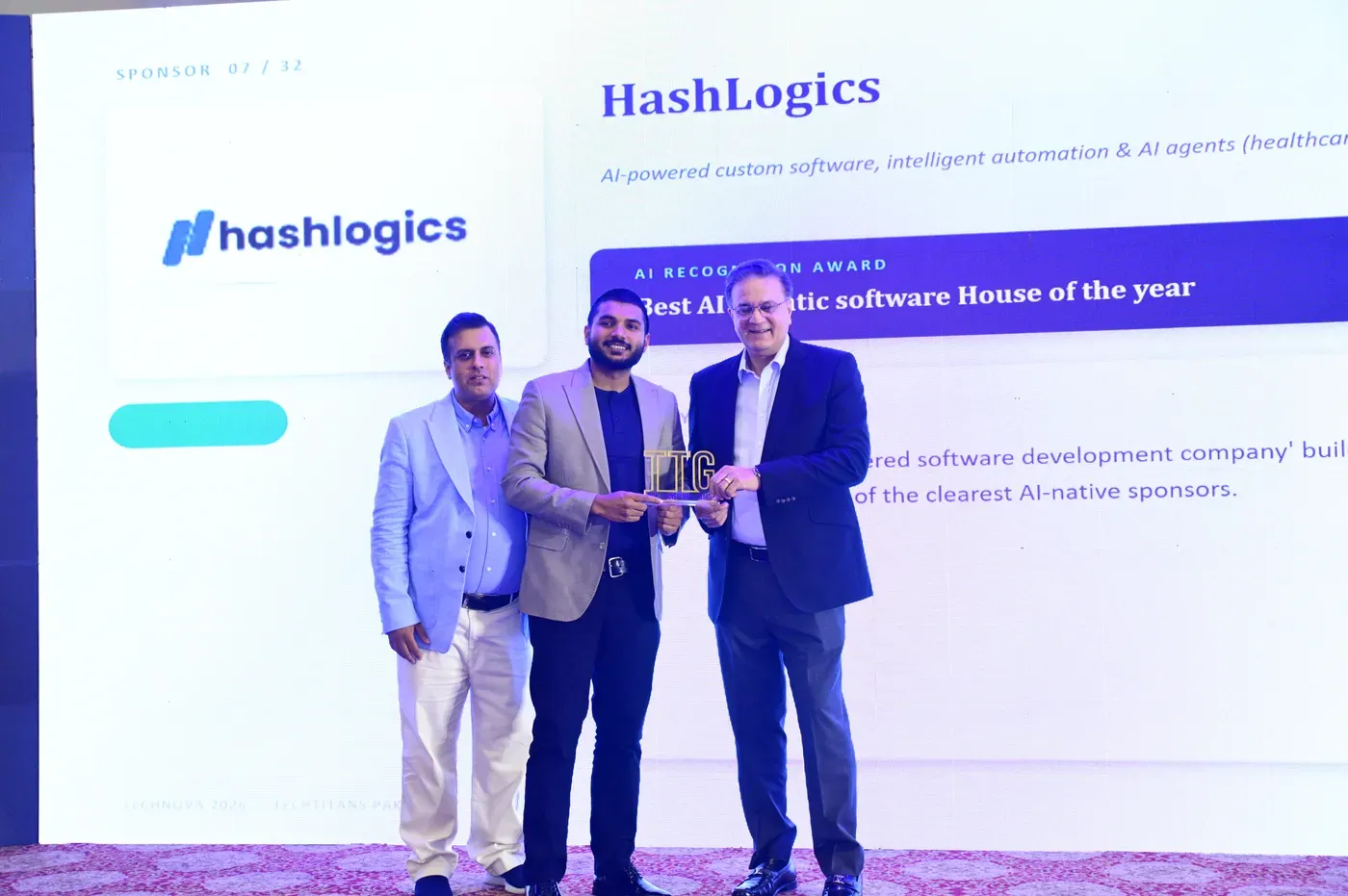
Abdul Basit founded Hashlogics in 2017, and the team runs from Lahore with a US LLC. Clients rate the work 4.8 on Clutch across 22 reviews, and in 2026 it was named Best AI-Native Software House of the Year at TechNova. Shift Link, the workforce-compliance and scheduling platform for regulated staffing, and WAIQ, the operations and execution platform for a multi-site business, are two of the systems we built and can show you.
Your audit call is with an engineer who has read travelers, load boards and month-end reconciliations like yours. Bring last month's numbers if you have them, and we'll work from those.
- NDA before the first conversation.
- No pitch on the call. A note you could hand to another firm.
- Fixed price per milestone from the Blueprint, so the number isn't a guess.
Go deeper
- AI and software for manufacturers and logistics →The hub: all eight areas, and the whole chain.
- Logistics software and automation →Written for 3PLs, freight brokers and fleets.
- 3PL software and automation →Warehousing, touches and the client portal.
- Freight brokerage software →Load boards, carrier vetting and the margin per load.
- Fleet management software →ELDs, cost per mile and the maintenance record.
- Custom software for manufacturers and logistics →Integration, EDI, portals and the multi-site layer.
- Best billing software for 3PLs →Ranked by how well each one bills the touch.
- How to automate 3PL billing by the touch →WMS events to invoice, with the unbilled touch flagged.
- How to stop re-keying orders into your TMS and ERP →Intake agents, and what they hand to a person.
- The load moved. Proof of it did not. →Offline capture, PODs and the dispute six weeks later.
- Shift Link case study →Eligibility checked before the shift, not after the audit.
